
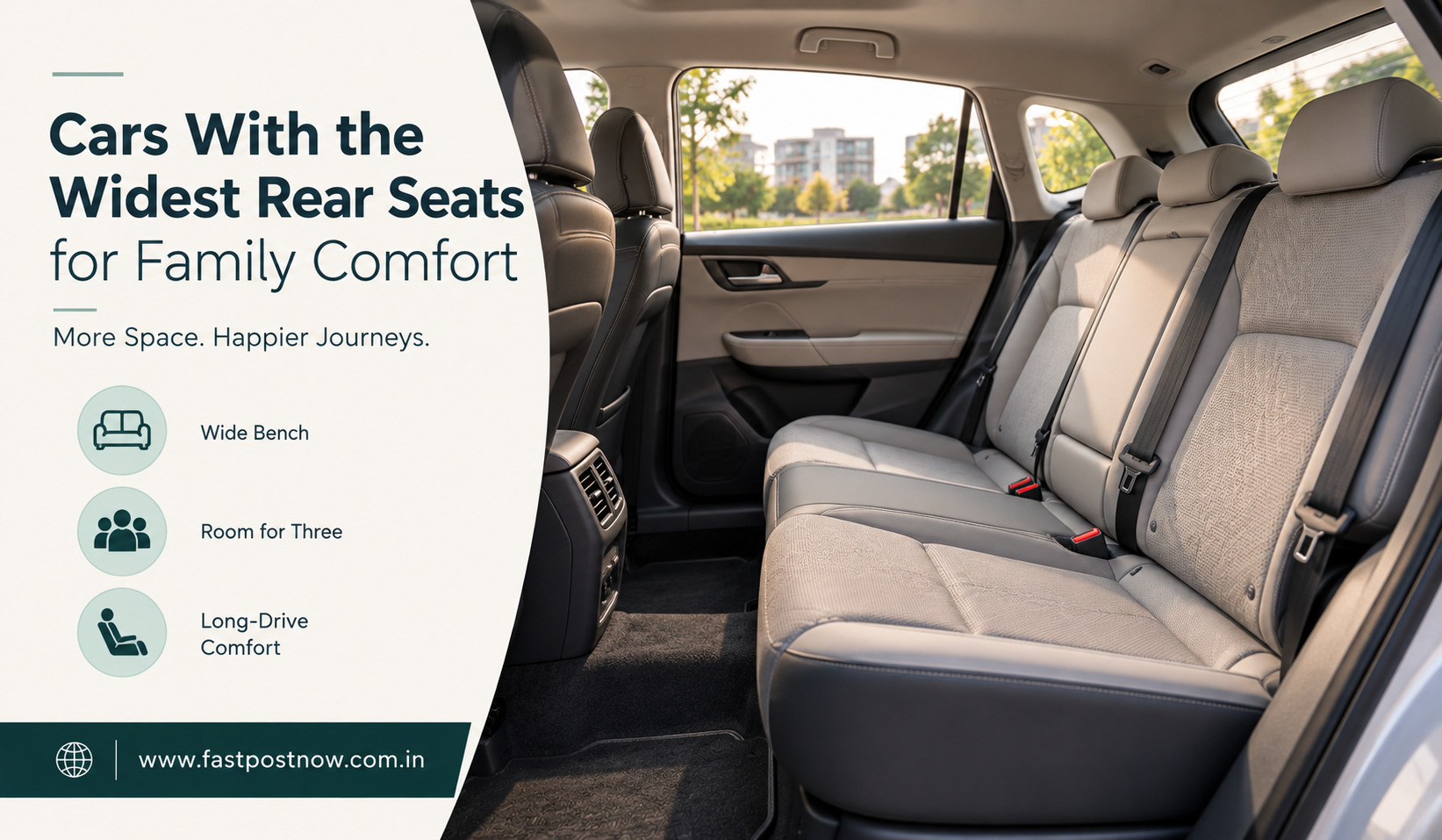
Rear-seat comfort becomes extremely important when a car is used regularly by a family. A vehicle may look spacious from the outside, but what matters during everyday travel is how comfortably three passengers can sit together, how much legroom is available, how easily passengers can enter and exit, and whether the rear seats provide enough support for longer journeys.
For Indian families, the rear bench often becomes the most frequently used part of the cabin. Children, parents, grandparents and other passengers may spend hours there during school runs, shopping trips and highway journeys. This is why buyers looking for a family car should pay close attention to rear-seat width rather than concentrating only on the front cabin or boot.
Several current Indian-market vehicles stand out for their family-friendly rear-seat arrangements. The Toyota Innova HyCross, Hyundai ALCAZAR, Kia Carens Clavis and Mahindra XUV 7XO are particularly interesting because they combine substantial cabin dimensions with flexible seating and comfort-focused equipment.
Why Rear-Seat Width Matters
A wide rear seat can make a major difference when three people need to sit in the second row.
A narrow bench can force passengers to sit close together, reducing shoulder room and making longer journeys uncomfortable. A wider cabin gives occupants more personal space and makes it easier to accommodate a child seat alongside adults.
However, width alone does not determine comfort. The shape of the seat cushion, centre-seat design, floor layout, transmission tunnel, door trim and position of the outer seats can all affect how spacious the rear bench feels.
This is why a physical test with three passengers is often more useful than simply comparing exterior dimensions.
Toyota Innova HyCross: A Strong Family-Space Choice
The Toyota Innova HyCross is one of the most compelling choices for buyers who place family comfort high on their priority list.
Toyota lists the Innova HyCross at 4,755 mm long, with a width of 1,845 mm on several grades and 1,850 mm on higher hybrid grades. Its wheelbase measures 2,850 mm. The model is available in 7- and 8-seat configurations depending on the grade.
Those dimensions give the Innova HyCross a substantial cabin footprint.
The 8-seat configuration uses a 60:40 split second-row seat with a long-slide function, while the 7-seat version uses captain seats with a walk-in slide. Toyota also provides reclining rear seats and adjustable rear headrests.
For families that regularly carry several people, the 8-seat version can be particularly useful because it provides a conventional second-row bench instead of captain seats.
The premium 7-seat versions go in a different direction. Toyota offers powered Ottoman second-row seats on higher hybrid grades, creating a much more luxurious experience for second-row passengers.
Hyundai ALCAZAR: Flexible Second-Row Seating
The Hyundai ALCAZAR is another current three-row family SUV designed around passenger flexibility.
Hyundai lists the current ALCAZAR at 4,560 mm long, 1,800 mm wide and 1,710 mm high. It is available as a 6- or 7-seater, giving buyers the option of choosing between captain-seat comfort and a traditional three-person second row.
For families primarily concerned with carrying three people in the second row, the 7-seat configuration is the more relevant version.
The 6-seat layout, however, can be more comfortable when only two second-row passengers usually travel. Individual captain seats provide additional separation and can create a more premium feel.
This distinction is important. The car with the widest bench is not automatically the most comfortable for every family. If your family normally has two adults in the second row, captain seats may be more desirable than maximum bench width.
Kia Carens Clavis: Family-Focused Interior Packaging
The Kia Carens Clavis is particularly interesting for buyers looking for a three-row vehicle with flexible seating.
Kia’s official specifications list the Carens Clavis at 4,550 mm long, 1,800 mm wide and 2,780 mm in wheelbase. The current model is offered in a 7-seat configuration, while selected versions also provide a 6-seat arrangement.
The second row uses a 60:40 split arrangement with sliding, reclining and tumble functions. Kia also offers a one-touch easy electric tumble function on applicable variants.
These features can make the second row more useful for families because passengers can adjust the seating position according to whether they need more legroom or additional space for passengers in the third row.
Kia also provides diffused air-conditioning vents for the second and third rows, which can be valuable during hot Indian summers.
Mahindra XUV 7XO: Wide SUV Proportions
The Mahindra XUV 7XO is another current seven-seat option worth considering.
Mahindra lists the XUV 7XO at 4,695 mm long, 1,890 mm wide and 1,755 mm high, with a 2,750 mm wheelbase. It is offered as a seven-seater.
Its 1,890 mm width is substantial for a family SUV. While exterior width does not directly equal rear-seat width, a wider vehicle can provide useful packaging opportunities for the cabin.
Mahindra has also focused heavily on passenger comfort. The company highlights high-density seat foam and plush pads, while higher variants offer ventilated front and rear seats.
For families who spend considerable time travelling together, these comfort-focused features can be just as important as the basic dimensions.
Three Adults in the Rear: What Should You Check?
If three adults regularly occupy the rear seat, do not rely only on the manufacturer’s brochure.
During a test drive, ask three adults to sit together in the second row. Check whether their shoulders touch, whether the middle passenger has sufficient knee room and whether the centre portion of the seat feels comfortable.
The floor is also important. A large centre hump can interfere with the feet of the middle passenger, even when the seat itself appears wide.
Door padding should also be considered. Thick door panels can reduce usable shoulder space and make a cabin feel narrower than its exterior dimensions suggest.
Legroom Is Just as Important as Width
A wide rear seat cannot compensate for inadequate legroom.
This is where wheelbase becomes useful as a broad indicator of interior packaging, although it should never be treated as a direct measurement of rear legroom.
The Innova HyCross has a 2,850 mm wheelbase, while the Carens Clavis has 2,780 mm and the XUV 7XO has 2,750 mm.
The actual amount of passenger space depends on how each manufacturer uses that wheelbase.
Second-row sliding seats can make an especially big difference. A family can move the second row backward when maximum legroom is required or forward when third-row passengers need additional space.
Second-Row Seat Adjustability Improves Comfort
Adjustability is one of the most useful features in a family car.
A fixed rear bench may be comfortable for one type of journey, but a sliding and reclining seat can adapt to different passengers and situations.
The Carens Clavis provides second-row sliding, reclining and tumble functions.
The Innova HyCross also offers long-slide functionality, while its 7-seat versions feature captain seats with walk-in slide functionality.
The ALCAZAR’s seating flexibility also allows buyers to choose between a 6-seat arrangement with captain seats and a 7-seat configuration.
For families, flexibility can sometimes be more valuable than a few extra millimetres of theoretical width.
Air-Conditioning Makes a Big Difference
India’s climate makes rear-seat ventilation particularly important.
A spacious rear bench can still become uncomfortable if passengers do not receive adequate airflow.
The Innova HyCross provides rear air-conditioning, with higher versions offering automatic climate control and a second-zone setup.
The Carens Clavis has roof-mounted diffused AC vents serving the second and third rows.
These systems can help distribute cool air more effectively throughout a large cabin.
Which Car Is Best for Three Adults in the Rear?
For families who regularly carry three adults in the second row, the Toyota Innova HyCross 8-seater deserves particular attention because of its dedicated three-person second-row arrangement, long-slide capability and large overall dimensions.
The Kia Carens Clavis 7-seater is another strong choice because its second row can slide and recline, giving families greater control over passenger and luggage space.
The Hyundai ALCAZAR 7-seater is worth considering for buyers who want an SUV format with a conventional second-row bench, while its 6-seat version is better suited to families prioritising individual second-row comfort.
The Mahindra XUV 7XO brings a wide 1,890 mm body and comfort-focused seating technology to the seven-seat SUV segment.
What About Child Seats?
Families with young children should also think about child-seat placement.
A rear seat needs enough width to accommodate a child seat without making the remaining passenger positions unusable. The position of ISOFIX points, seat-belt buckles and the shape of the cushion can affect how easily multiple occupants fit together.
If you regularly carry two child seats and an adult, physically test that exact arrangement before buying.
This can eliminate some seemingly spacious vehicles from consideration very quickly.
Final Verdict
When looking for cars with spacious rear seats, it is tempting to compare only exterior width. However, genuine family comfort depends on a combination of cabin packaging, seat width, legroom, floor design, seat cushioning, adjustability and ventilation.
The Toyota Innova HyCross stands out for its substantial dimensions, long wheelbase and highly flexible second-row arrangements. The Kia Carens Clavis offers impressive seating adjustability and family-focused interior features. The Hyundai ALCAZAR provides the choice between a three-person bench and captain-seat configuration, while the Mahindra XUV 7XO combines a broad body with a strong focus on passenger comfort.
Ultimately, the best rear seat is the one that works for your actual family. Before buying, place three adults—or your child seats and passengers—in the second row, check legroom, test the centre position and spend enough time sitting there to judge comfort.
A specification sheet can tell you how wide a car is. Only a real-world test can tell you whether the rear seat is genuinely comfortable for your family.