
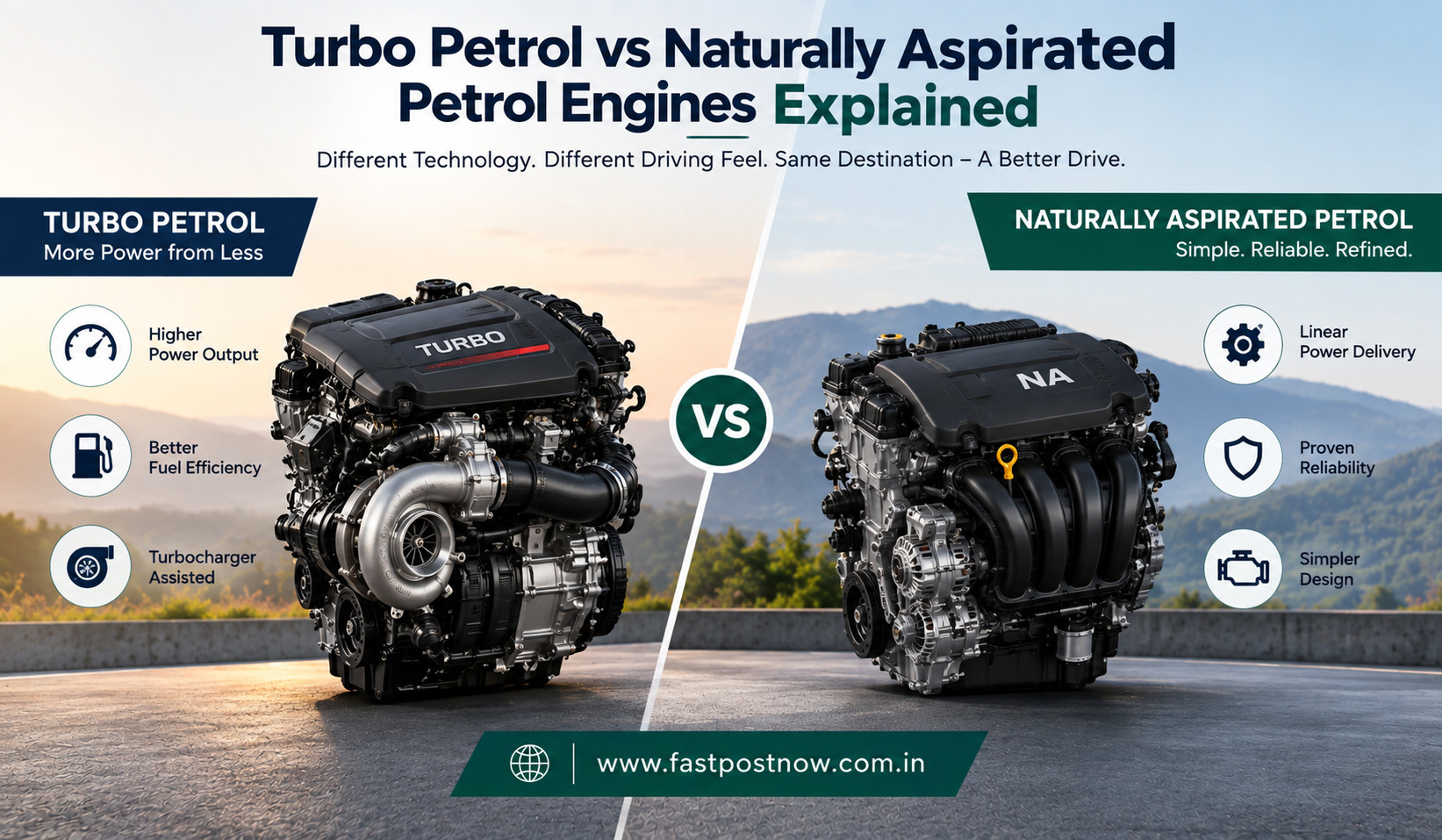
Petrol engines are available in many different forms, and one of the most important choices for a new-car buyer is whether to select a turbo petrol engine or a naturally aspirated petrol engine. Both use petrol as fuel and rely on internal combustion, but the way they produce power is different.
A naturally aspirated engine draws air into the cylinders without forced induction. A turbocharged engine uses a turbocharger to push additional air into the engine, allowing it to generate more power and torque from a relatively compact displacement.
This difference can noticeably affect acceleration, highway performance, fuel consumption, driving feel and even the type of maintenance a buyer may need to consider.
Modern Indian cars provide plenty of examples. The Hyundai CRETA currently offers a 1.5-litre MPi naturally aspirated petrol engine as well as a 1.5-litre Turbo GDi petrol engine. Hyundai also offers both naturally aspirated and turbo-petrol engines in the VERNA. Kia’s current Seltos similarly offers Smartstream 1.5-litre naturally aspirated petrol and 1.5-litre T-GDi turbo-petrol options.
What Is a Naturally Aspirated Petrol Engine?
A naturally aspirated, or NA, petrol engine does not use a turbocharger or supercharger to force air into the cylinders.
Instead, the engine draws air into the combustion chamber naturally as the pistons move and the intake valves open. The engine’s displacement, air intake system, fuel delivery and engine tuning determine how much power it can produce.
The main advantage is simplicity. With fewer forced-induction components, an NA engine can provide predictable and linear power delivery.
The Hyundai CRETA’s current 1.5-litre MPi petrol engine is an example of this type of powertrain. Hyundai pairs it with a 6-speed manual or IVT transmission depending on the variant.
What Is a Turbo Petrol Engine?
A turbo petrol engine uses a turbocharger to increase the amount of air entering the engine.
The turbocharger uses energy from exhaust gases to spin a turbine. This turbine drives a compressor that pushes additional air into the engine. Because more air is available for combustion, the engine can produce more power than a naturally aspirated engine of similar displacement.
The important benefit is that a relatively small engine can deliver strong performance.
The current Hyundai CRETA’s 1.5-litre Turbo GDi petrol engine is rated at 160 PS and 253 Nm of torque and is paired with a 7-speed dual-clutch transmission in the regular CRETA lineup.
These figures illustrate why turbo engines have become increasingly popular in modern SUVs and sedans.
Turbo Engines Usually Produce More Torque
One of the biggest differences drivers notice is torque.
Turbocharging can allow an engine to produce strong torque at relatively low engine speeds. This can make acceleration feel stronger, particularly when overtaking or climbing an incline.
For example, Hyundai’s current CRETA turbo produces 253 Nm of torque, while the company’s 1.5-litre MPi petrol engine produces around 143.8 Nm.
The difference is not simply about numbers on a specification sheet. Extra torque can make a vehicle feel more effortless when carrying passengers or accelerating onto a highway.
However, the actual driving experience also depends on transmission calibration, vehicle weight, gearing and throttle response.
Naturally Aspirated Engines Deliver Linear Power
Naturally aspirated petrol engines often provide a more predictable relationship between accelerator input and engine response.
As the driver presses the accelerator, power generally builds progressively with engine speed. There is no turbocharger that needs to build boost before delivering its additional airflow.
This characteristic can make an NA engine feel smooth and easy to control during everyday driving.
For people who mainly drive around town and prefer relaxed acceleration rather than strong bursts of torque, this response can be perfectly adequate.
Turbo Engines Can Feel Stronger During Overtaking
On highways, the additional torque of a turbo petrol engine can become particularly useful.
When overtaking another vehicle, the driver may need quick acceleration. A turbocharged engine can deliver strong mid-range performance, reducing the need to keep the engine at very high revolutions.
This is one reason turbo petrol engines are popular in larger cars that need a balance between performance and efficiency.
The Kia Seltos is a current example. Kia’s official specifications list the 1.5-litre Smartstream naturally aspirated petrol engine and the 1.5-litre Smartstream T-GDi turbo-petrol engine, with transmission combinations varying by trim.
Turbo Lag Is a Characteristic to Understand
Older turbocharged engines were often associated with noticeable turbo lag. This refers to a short delay between pressing the accelerator and the turbocharger building sufficient boost.
Modern turbo engines have become considerably more responsive because of improvements in turbocharger design, engine management and transmission technology.
Nevertheless, the driving characteristics can still vary between engines. Some deliver boost very smoothly, while others provide a more noticeable increase in acceleration as the turbo comes into its effective operating range.
A test drive is therefore important if immediate throttle response is a priority.
Naturally Aspirated Engines Can Feel Simpler
One reason buyers continue to choose naturally aspirated petrol engines is their straightforward character.
There is no turbocharger adding another major forced-induction component to the powertrain. That does not mean an NA engine requires no maintenance, but the mechanical layout is generally less complicated than a turbocharged setup.
For buyers who plan to keep a vehicle for many years, long-term ownership considerations can be important.
However, modern turbo engines are not inherently unreliable. Proper servicing, appropriate engine oil, sensible driving habits and following the manufacturer’s maintenance schedule are much more important than simply choosing an engine based on whether it has a turbo.
Fuel Efficiency Depends on How You Drive
It is tempting to assume that a smaller turbo engine will always consume less fuel than a larger naturally aspirated engine. Real-world fuel economy is more complicated.
Turbo engines can provide strong performance from a relatively small displacement, but using that performance frequently can increase fuel consumption.
A driver who accelerates gently may benefit from the engine’s efficiency potential, while aggressive acceleration and frequent high-boost driving can use considerably more fuel.
Traffic conditions, vehicle weight, tyre pressure, air-conditioning use, road conditions and driving habits also influence mileage.
Therefore, buyers should not select between NA and turbo engines based only on claimed fuel-efficiency figures.
Transmission Choice Changes the Experience
The gearbox can significantly influence how either type of engine feels.
The current Hyundai CRETA’s naturally aspirated petrol engine is available with a 6-speed manual or IVT, while its turbo-petrol version uses a 7-speed DCT.
The Kia Seltos offers an even wider combination of engine and transmission choices, including 6-speed manual, IVT, 6-speed iMT and 7-speed DCT options depending on the engine and variant.
This means two cars with similar engine specifications can feel completely different behind the wheel because of their transmission programming.
Which Engine Is Better for City Driving?
For primarily urban driving, a naturally aspirated petrol engine can be an excellent choice.
Its predictable response can make it easy to control in crowded traffic. If the vehicle is relatively light and the engine is adequately powered, there may be little reason to choose a turbo purely for city commuting.
However, a turbo petrol engine can also work very well in cities. Its stronger low- and mid-range torque can make frequent acceleration easier, particularly when the car is carrying passengers.
The choice ultimately depends on whether you prioritize simplicity and smoothness or stronger performance.
Which Is Better for Highway Driving?
Highway drivers may appreciate the stronger torque of a turbo petrol engine.
Extra mid-range performance can make overtaking, climbing gradients and maintaining speed with a loaded vehicle more comfortable.
That does not make naturally aspirated engines unsuitable for highways. A well-matched NA engine can cruise comfortably, especially when the driver is willing to use the gearbox effectively.
For frequent highway travel, however, buyers should pay particular attention to torque delivery, transmission behaviour and the vehicle’s performance with passengers and luggage.
Maintenance: What Should Buyers Know?
Both engine types require regular maintenance.
Turbo petrol engines have additional components such as the turbocharger, associated oil and air systems and more complex engine management. Following the manufacturer’s recommended service schedule becomes particularly important.
Naturally aspirated engines have fewer forced-induction components, but they still require regular oil changes, filter replacement, spark-plug maintenance and other scheduled inspections.
It is also important to use the correct engine oil and follow the manufacturer’s recommendations rather than relying on generic service advice.
Turbo Petrol vs Naturally Aspirated Petrol: Which Should You Choose?
A naturally aspirated petrol engine may be the better choice if you want predictable power delivery, straightforward everyday performance and primarily drive in urban conditions.
A turbo petrol engine may be more suitable if you value stronger acceleration, higher torque and better performance during highway driving or when the vehicle is heavily loaded.
The Hyundai CRETA illustrates the difference particularly well. Its current lineup combines a 1.5-litre MPi petrol engine with a 1.5-litre Turbo GDi petrol engine, giving buyers two distinct petrol-engine experiences within the same model family.
Final Verdict
There is no universal winner between turbo petrol and naturally aspirated petrol engines.
Turbocharging can deliver significantly more torque and power from a compact engine, making it attractive to drivers who want energetic acceleration and stronger highway performance. Naturally aspirated engines, meanwhile, offer a linear response and straightforward driving character that can suit relaxed city use.
When choosing a new car, don’t look only at horsepower or engine size. Consider torque delivery, transmission type, traffic conditions, highway usage, maintenance requirements and your preferred driving style.
For buyers who want effortless acceleration and stronger performance, a turbo petrol engine can be compelling. For those who value predictable response and uncomplicated everyday driving, a naturally aspirated petrol engine may be the better fit.
The best engine is ultimately the one that matches the way you drive—not simply the one with the bigger number on the specification sheet.