
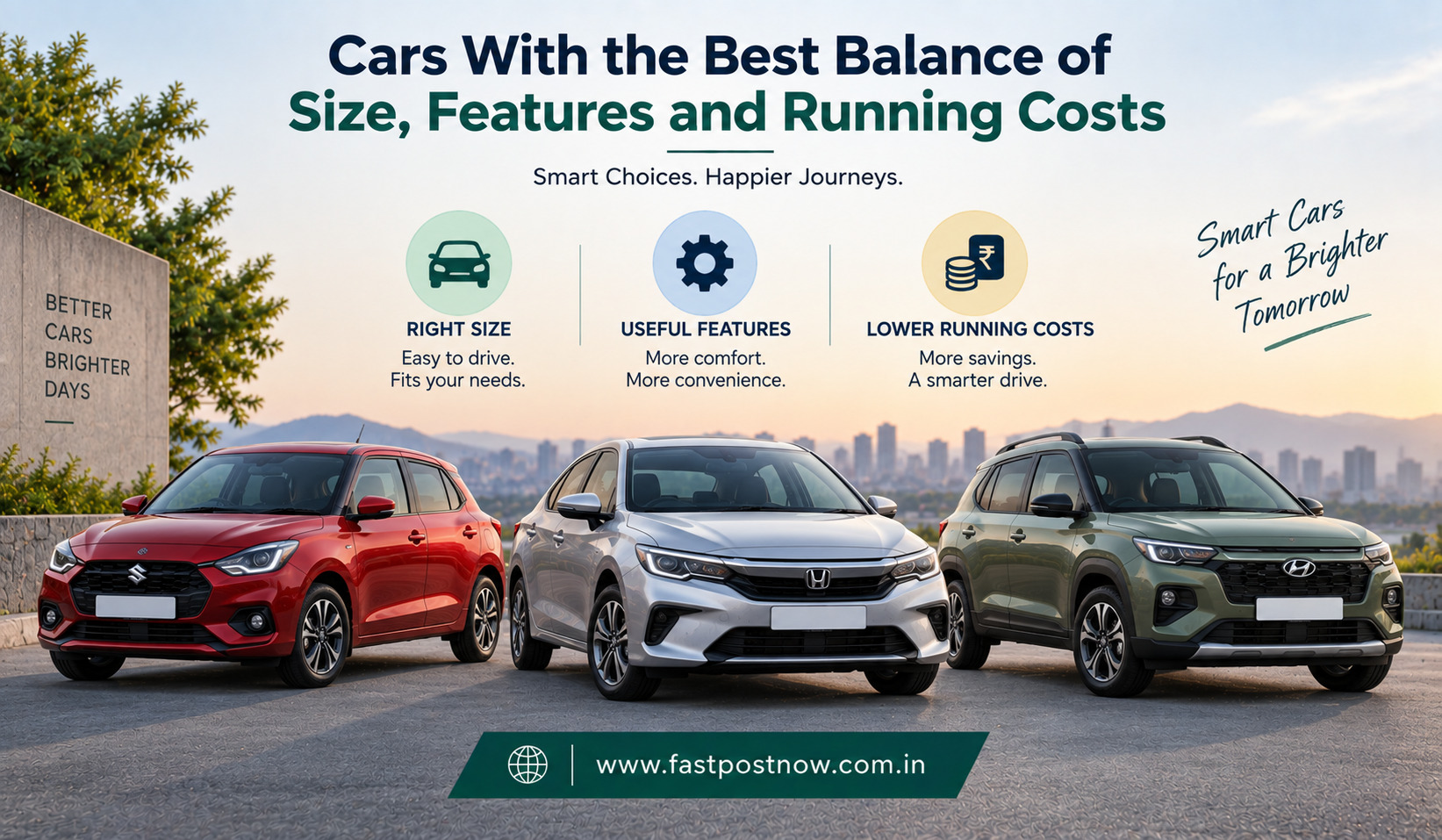
Choosing a new car is rarely about finding the biggest vehicle or the one with the longest feature list. For most Indian buyers, the better approach is to find a car that offers the right balance of size, features, comfort, practicality and running costs.
A very small car can be inexpensive to operate but may feel restrictive for a growing family. A larger SUV can provide more space and technology, but its purchase price, fuel consumption, tyres and maintenance may increase the overall ownership cost. The sweet spot is a vehicle that gives you enough space and equipment without becoming unnecessarily expensive to own.
Current Indian-market cars such as the Hyundai EXTER, Hyundai VENUE and Hyundai CRETA illustrate three different approaches to this balance. All three are currently listed by Hyundai India, but they target different types of buyers.
What Makes a Car Well Balanced?
A well-balanced car should perform several jobs without becoming excessive in any one area.
For an urban buyer, compact dimensions can make parking and navigating narrow roads easier. Families may instead prioritise rear-seat space and luggage capacity. Technology such as wireless smartphone connectivity can improve convenience, while safety equipment can add meaningful everyday value.
Running costs also go beyond fuel consumption. Insurance, servicing, tyres, replacement parts and the initial purchase price all contribute to the cost of ownership.
Therefore, the most practical car is not necessarily the cheapest car. It is the one that provides the features and space you actually need without paying for capabilities you rarely use.
Hyundai EXTER: Compact Size With Useful Features
The Hyundai EXTER is an interesting choice for buyers who want a small SUV-style vehicle without moving into a larger and more expensive category.
The current EXTER measures 3,830 mm in length, 1,723 mm in width and 1,643 mm in height, with a 2,450 mm wheelbase. Hyundai lists it as a micro SUV.
Its compact dimensions can be useful for city driving, particularly where parking space is limited. At the same time, Hyundai has equipped the current model with features that go beyond basic urban transportation.
The EXTER offers a 1.2-litre four-cylinder petrol engine producing 83 PS and 113.8 Nm, with a 5-speed manual or Smart Auto AMT depending on the variant. A factory-fitted CNG option is also available.
For buyers concerned about running expenses, the CNG version is particularly relevant. Hyundai’s dual-cylinder CNG arrangement is designed to preserve usable luggage space, with the manufacturer quoting 225 litres of boot space for the CNG version. Petrol versions offer 391 litres of boot capacity.
The EXTER also provides six airbags as standard, ESC, hill-start assist and other safety technologies, while higher variants add features such as wireless Android Auto and Apple CarPlay, connected-car functions and a dashcam.
This combination makes the EXTER appealing to buyers who want a relatively compact vehicle with modern equipment.
Hyundai VENUE: A Middle Ground for Many Buyers
The Hyundai VENUE sits above the EXTER in size and offers a broader choice of engines and equipment.
The current VENUE measures 3,995 mm long, 1,800 mm wide and 1,665 mm high, with a 2,520 mm wheelbase and a 45-litre fuel tank.
That makes it larger than the EXTER while remaining relatively compact compared with larger SUVs.
One of the VENUE’s strengths is its powertrain variety. Hyundai currently offers a 1.2-litre naturally aspirated petrol, 1.0-litre turbo-petrol and 1.5-litre diesel. Transmission choices vary by engine and variant, including manual, DCT and automatic options.
This variety allows buyers to select a setup based on how they drive rather than accepting a single engine choice.
The VENUE also focuses heavily on cabin technology and comfort. Depending on the variant, Hyundai lists features such as dual 12.3-inch displays, rear window sunshades, two-step reclining rear seats and rear AC vents.
For someone who wants more cabin space and equipment than a micro SUV but does not want to move to a larger SUV, the VENUE can be a logical middle ground.
Hyundai CRETA: More Space Without Going Full-Size
The Hyundai CRETA is the more substantial option among these three vehicles.
It is aimed at buyers who want greater cabin presence, more powertrain choices and a larger overall vehicle without stepping into a full-size SUV.
The current CRETA offers three engine choices: a 1.5-litre naturally aspirated petrol, 1.5-litre diesel and 1.5-litre turbo-petrol. Transmission options include manual, IVT, automatic and 7-speed DCT depending on the engine and variant.
This range makes the CRETA particularly versatile.
A buyer who mainly drives in the city can consider the naturally aspirated petrol and IVT combination, while someone who travels long distances may prefer the diesel. Buyers prioritising performance can consider the turbo-petrol DCT.
The CRETA also has a 50-litre fuel tank, which can be useful for longer journeys between fuel stops.
Its larger size naturally comes with a higher purchase and ownership commitment than a smaller vehicle, so it makes the most sense when the additional space, comfort and performance are actually useful to the buyer.
Size Versus Running Costs
Size and running costs are closely connected, but not always in a simple way.
A smaller vehicle generally requires less material and may use smaller tyres, while a larger SUV can have more expensive components. However, engine technology and fuel choice can have a bigger influence on fuel expenditure than body size alone.
The EXTER’s factory CNG option gives efficiency-focused buyers an alternative to petrol. The VENUE offers petrol and diesel powertrains, while the CRETA also provides petrol and diesel choices.
Your annual mileage should therefore influence the decision.
Someone driving a few kilometres each day may benefit more from a compact, easy-to-park vehicle than from paying extra for a larger car. A high-mileage driver should look more carefully at fuel type, efficiency and service requirements.
Features Should Be Evaluated for Real Use
Modern cars can come with impressive technology, but not every feature has equal value.
For example, a wireless smartphone connection can be useful every day, while a feature used only occasionally may not justify a substantial increase in purchase price.
The EXTER offers wireless Android Auto and Apple CarPlay on applicable variants, while the VENUE offers advanced displays, rear sunshades and rear AC vents on selected trims. The CRETA also provides a broad range of convenience and safety equipment depending on the variant.
When comparing variants, focus on features that improve everyday usability, safety and comfort rather than simply counting how many features appear in the brochure.
Safety Should Be Part of the Balance
A car that is inexpensive but lacks important safety equipment is not necessarily good value.
The current EXTER includes six airbags, ABS with EBD, ESC and other safety features across its lineup. Hyundai’s VENUE also lists front, side and curtain airbags along with ABS with EBD and other safety technologies. The CRETA includes six airbags, ESC, VSM and hill-start assist in its current feature list.
However, equipment can vary between variants, so buyers should always check the exact specification of the version they intend to purchase.
Which Size Makes the Most Sense?
For a single driver or small family that spends most of its time in crowded cities, the EXTER’s compact footprint can be attractive.
For a buyer who wants a little more space and a wider choice of engines and equipment, the VENUE provides a useful middle ground.
The CRETA makes more sense when rear-seat comfort, highway ability, larger-cabin practicality and greater powertrain choice are more important than keeping the vehicle as compact as possible.
There is no benefit in buying a larger vehicle simply because it looks more substantial if you rarely use the additional space.
Don’t Ignore Parking and Road Conditions
Indian driving conditions can vary enormously between cities.
A compact vehicle can be easier to park in crowded neighbourhoods and shopping areas. On the other hand, buyers who regularly travel on highways or poorly surfaced roads may appreciate the additional space and capability of a larger SUV.
Ground clearance can also matter when dealing with speed breakers and uneven roads. Hyundai lists the current EXTER with 185 mm of ground clearance, making it well suited to many everyday urban conditions.
But ground clearance should not be considered in isolation. Suspension tuning, tyre profile, wheel size and driving style also affect how a car behaves on imperfect roads.
Which Car Offers the Best Overall Balance?
The answer depends on what you mean by “balance.”
The Hyundai EXTER is a strong option for buyers who want compact dimensions, practical features and the availability of CNG. Its relatively small footprint makes it particularly suited to urban use.
The Hyundai VENUE is arguably the middle-ground choice. It offers a larger body, multiple engine options and a strong technology package without moving into the size of a larger SUV.
The Hyundai CRETA is better suited to buyers who are prepared to spend more for additional space, engine choices and broader long-distance capability.
Final Verdict
The best-balanced car is not necessarily the smallest, cheapest or most feature-packed model. It is the vehicle that matches your daily routine while keeping ownership costs reasonable.
For mostly urban driving and maximum compactness, the EXTER deserves consideration. For buyers seeking a middle ground between city-friendly dimensions, features and powertrain choice, the VENUE is a compelling option. For families that want more space and stronger all-round highway capability, the CRETA offers a broader package.
Before buying, calculate your annual kilometres, compare fuel costs, check insurance and service expenses, and test the car with your usual passengers. Most importantly, choose the size you actually need.
A well-balanced car should make daily life easier—not simply make the specification sheet look impressive.