
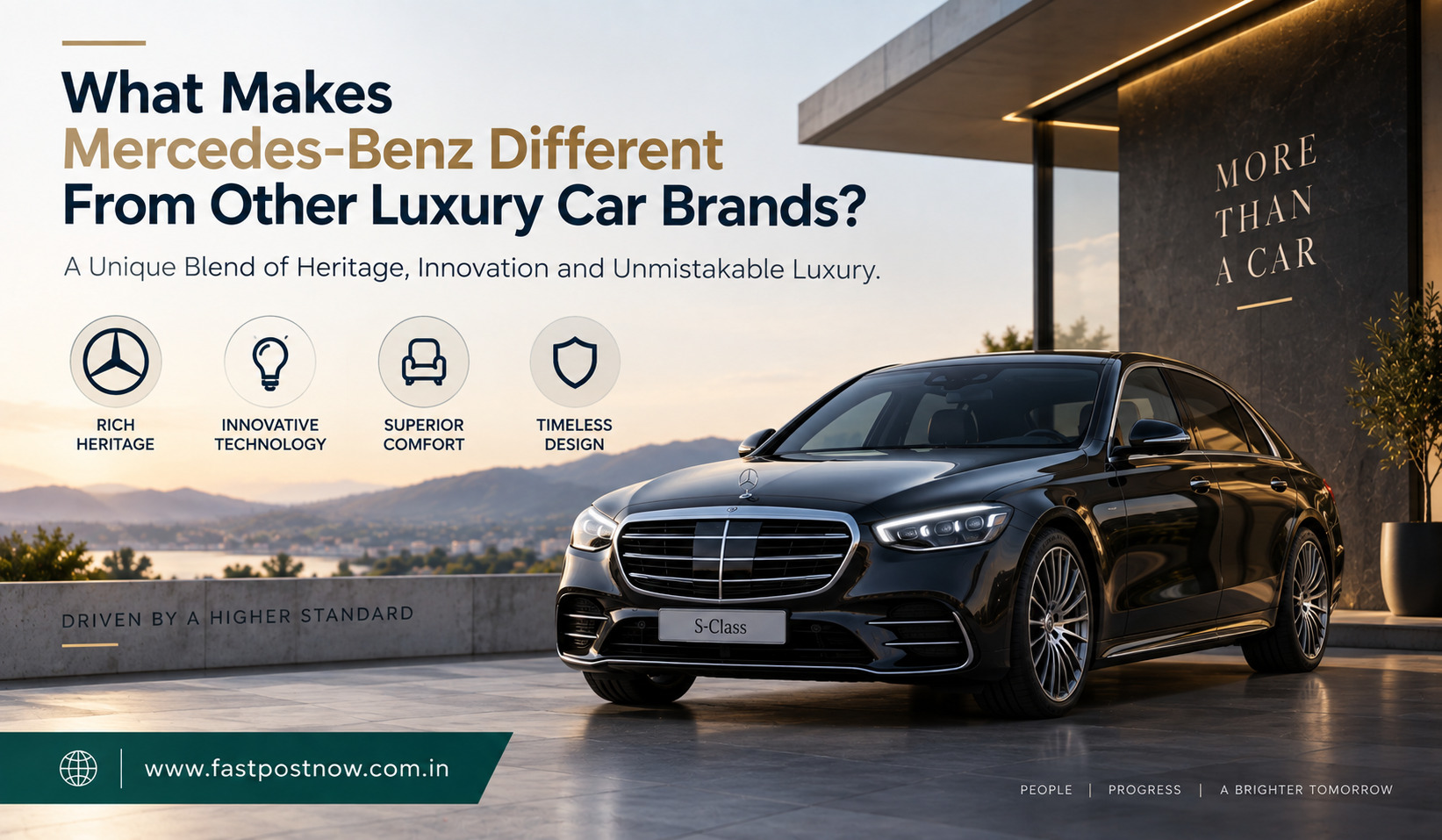
Mercedes-Benz occupies a distinctive position in the luxury-car market. The brand is associated with premium design, sophisticated engineering, powerful engines and high levels of comfort, but its appeal goes beyond simply offering expensive cars. Mercedes-Benz has spent decades developing a particular approach to luxury that combines technology, comfort, performance and a strong sense of identity.
Today, luxury-car buyers in India have many choices from established European and global manufacturers. Yet Mercedes-Benz continues to stand apart through its model range, interior technology, engineering philosophy and attention to passenger experience.
So, what exactly makes Mercedes-Benz different from other luxury car brands?
A Legacy Built Around the Automobile
One of Mercedes-Benz’s strongest differentiators is its history.
The company traces its automobile heritage to the invention of the modern automobile and continues to build its brand around innovation. Mercedes-Benz itself describes its history as beginning with the invention of the automobile in 1886.
That heritage influences how the company positions its modern vehicles. Mercedes-Benz does not rely solely on heritage styling or a famous badge. It connects its history with continuing developments in safety, comfort, digital technology and vehicle engineering.
For buyers, this creates a sense that they are purchasing not just a luxury vehicle but a product from a company with an unusually long automotive history.
Luxury Is About More Than Exterior Design
Luxury cars often compete through styling, but Mercedes-Benz places considerable emphasis on the experience inside the vehicle.
The current E-Class LWB, for example, combines a premium cabin with the latest-generation MBUX multimedia system, multicontour seating and sophisticated interior materials. Mercedes-Benz also offers MANUFAKTUR personalisation options for customers who want a more individual appearance.
This approach reflects an important part of Mercedes-Benz’s philosophy: luxury should be experienced every time the vehicle is used.
The dashboard, seats, lighting, screens, materials and controls are designed to make ordinary journeys feel more special.
MBUX Makes the Cabin More Digital
One of Mercedes-Benz’s most recognizable modern technologies is MBUX.
The Mercedes-Benz User Experience system combines infotainment, navigation, voice interaction and connected services. The company says its latest MBUX systems use artificial intelligence and large language models to make voice interaction more conversational and contextual.
The “Hey Mercedes” voice assistant allows drivers to control functions and interact with the vehicle using natural speech. Mercedes-Benz also provides over-the-air updates and a range of Digital Extras.
This gives Mercedes-Benz a different approach to luxury. Instead of treating technology as a collection of isolated features, the brand increasingly integrates software into the overall driving experience.
The MBUX Hyperscreen Adds a Visual Identity
Mercedes-Benz has also developed large digital displays that have become an important part of its modern electric vehicles.
The EQS, for example, features the MBUX Hyperscreen, where multiple displays are integrated behind a large glass surface. The EQS SUV uses the same concept, combining three displays into a visually continuous screen unit.
This is more than simply installing a larger screen. The design makes the dashboard itself part of the vehicle’s identity.
For technology-focused luxury buyers, this combination of digital interfaces and premium materials helps distinguish Mercedes-Benz from more traditional cabin designs.
Mercedes-Benz Offers Different Types of Luxury
Another major difference is the breadth of its Indian portfolio.
Mercedes-Benz India’s current lineup covers everything from the C-Class to the E-Class, S-Class and Maybach models, as well as SUVs such as the GLA, GLC, GLE and GLS. Its electric range includes models such as the EQS and EQS SUV.
This means luxury does not have to mean one particular type of vehicle.
A buyer looking for a relatively compact luxury sedan can consider the C-Class. Someone who prioritises rear-seat comfort may prefer the E-Class LWB. Buyers seeking larger SUVs have options such as the GLC, GLE and GLS, while customers looking for an iconic off-road design can look toward the G-Class.
This broad range allows Mercedes-Benz to serve different interpretations of luxury while maintaining a recognizable brand identity.
The E-Class Shows Mercedes-Benz’s Focus on Rear Passengers
In many markets, luxury cars are designed primarily around the driver. Mercedes-Benz also pays considerable attention to passengers, particularly in vehicles such as the E-Class LWB sold in India.
The current E-Class LWB emphasizes rear-seat comfort and offers features designed around a more relaxing passenger experience. Its interior combines spaciousness with advanced infotainment and comfort technology.
This is especially relevant in India, where luxury-car buyers may spend significant time in the rear seat.
The idea is simple: a premium car should not only be enjoyable to drive but also comfortable when someone else is driving.
Safety Has Always Been Part of the Brand
Mercedes-Benz has historically placed strong emphasis on automotive safety, and modern vehicles continue that philosophy through electronic systems, driver assistance and integrated safety technologies.
The company’s approach increasingly combines active assistance with connected services and vehicle intelligence.
Mercedes-Benz also provides 24×7 roadside assistance through its Mobilo service and has developed connected services that allow owners to access vehicle information and service-related functions through their smartphones.
For luxury buyers, this broader support ecosystem can be just as important as the vehicle itself.
Engineering and Driving Dynamics Remain Important
Technology and comfort have become major parts of modern luxury, but Mercedes-Benz has not abandoned driving performance.
Its range includes conventional petrol and diesel vehicles, plug-in hybrids and fully electric models. The current India portfolio reflects this variety, with different propulsion systems available across the model range.
The GLC, for example, combines SUV practicality with Mercedes-Benz’s premium design and technology approach.
At the other end of the spectrum, the electric EQS demonstrates how Mercedes-Benz is adapting its luxury philosophy to electric mobility. The EQS 450 4MATIC, for example, is officially listed with 265 kW of power, 800 Nm of nominal torque and all-wheel drive.
The important point is that electrification has not replaced the brand’s emphasis on luxury. Instead, Mercedes-Benz is applying its established luxury philosophy to a new type of powertrain.
Personalisation Is Another Mercedes-Benz Strength
Luxury buyers often want their vehicles to feel individual rather than identical to every other car on the road.
Mercedes-Benz addresses this through equipment choices, colours, trims and personalisation programmes. The E-Class, for example, offers MANUFAKTUR options that allow customers to select more distinctive finishes and interior details.
This focus on personalisation helps move the ownership experience beyond simply selecting a standard vehicle configuration.
For high-end buyers, the ability to create a more individual specification can be an important part of the luxury experience.
The G-Class Has a Unique Identity
Few luxury vehicles have an identity as distinctive as the Mercedes-Benz G-Class.
While many luxury SUVs emphasize smooth road manners and urban comfort, the G-Class retains a strong connection to its rugged design heritage.
Its upright shape, distinctive exterior details and recognizable silhouette make it immediately identifiable. At the same time, Mercedes-Benz has transformed the G-Class into a premium lifestyle vehicle without abandoning its iconic character.
The current India model range includes both conventional G-Class versions and an electric G-Class.
That combination of heritage, luxury and modern technology gives the G-Class a position that is difficult to replicate.
Electric Luxury Is Becoming More Important
Mercedes-Benz is also differentiating itself through electric luxury.
The EQS and EQS SUV demonstrate the company’s approach to premium electric vehicles, combining large batteries, advanced digital technology, quiet electric propulsion and high levels of cabin comfort.
The EQS SUV, for example, offers a 118 kWh usable battery, 200 kW maximum DC charging capacity and a 5-seat configuration in the EQS 450 4MATIC specification shown on Mercedes-Benz India’s official website.
This shows that Mercedes-Benz is not treating electric cars simply as environmentally focused alternatives. It is positioning them as premium products in their own right.
Mercedes-Benz Blends Technology With Traditional Luxury
Perhaps the biggest difference is the way Mercedes-Benz combines old and new ideas.
Traditional luxury involves premium materials, craftsmanship, comfort, quietness and exclusivity. Modern luxury increasingly involves software, connectivity, screens, artificial intelligence, personalisation and electric propulsion.
Mercedes-Benz attempts to bring these two definitions together.
A vehicle such as the E-Class can provide handcrafted interior details and comfort-focused seating while also offering advanced digital technology. An EQS can deliver electric performance alongside an elaborate luxury interior and Hyperscreen interface.
This mixture allows the brand to appeal to buyers who appreciate traditional luxury as well as those who expect the latest technology.
Is Mercedes-Benz Better Than Other Luxury Brands?
It would be difficult to say that Mercedes-Benz is universally better than every competing luxury manufacturer.
Different brands emphasize different strengths. Some may prioritize driving dynamics, others design, technology, reliability or performance.
Mercedes-Benz’s strength is its ability to combine several aspects of luxury into one package. Its vehicles generally aim to provide a distinctive design, comfortable cabin, advanced technology, strong performance and a prestigious ownership experience.
That combination is what gives the brand its particular position in the luxury market.
Final Thoughts
Mercedes-Benz is different from other luxury car brands because it treats luxury as a complete experience rather than a collection of expensive features.
Its long automotive history gives the brand a distinctive foundation, while technologies such as MBUX and the MBUX Hyperscreen demonstrate its focus on the future. Its range—from the C-Class and E-Class to the GLC, GLE, S-Class, G-Class and EQS—also gives buyers several interpretations of premium motoring.
The brand’s emphasis on interior comfort, personalisation, digital technology, safety and engineering creates a recognizable Mercedes-Benz character.
Ultimately, what makes Mercedes-Benz stand out is not one engine, one screen or one design feature. It is the way the company brings heritage, technology, comfort, craftsmanship and performance together in a single ownership experience.