
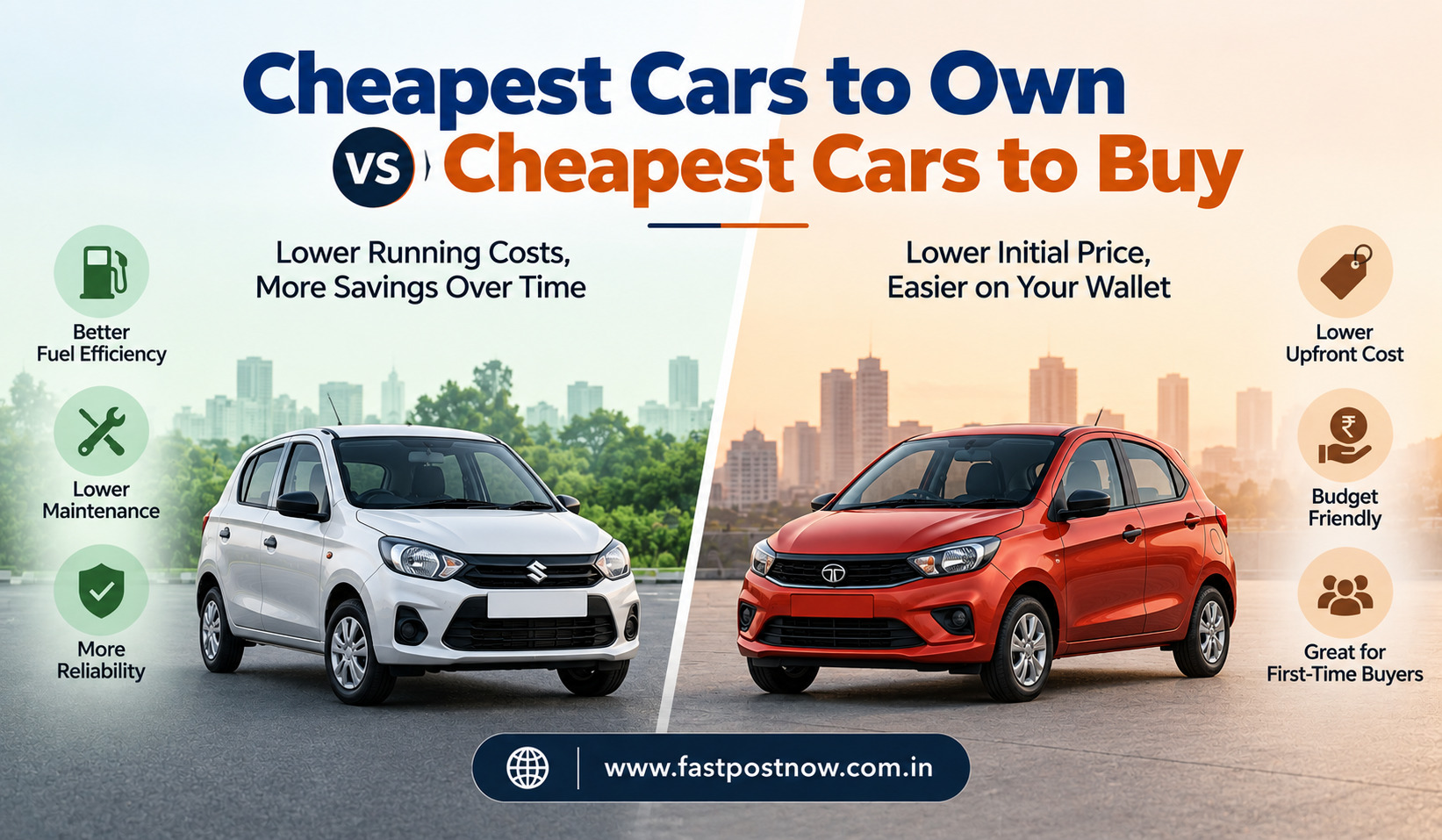
Buying the cheapest car is not always the same as choosing the cheapest car to own. A low purchase price can make a car attractive at the showroom, but ownership costs continue long after the initial payment. Fuel bills, insurance, servicing, tyres, repairs, depreciation and financing can all change the real cost of keeping a car.
For Indian buyers, affordable hatchbacks remain popular because they are relatively easy to drive in crowded cities and generally cost less to maintain than larger vehicles. Models such as the Maruti Suzuki Alto K10, S-Presso, Celerio and WagonR, along with the Renault Kwid, Hyundai Grand i10 NIOS and Tata Tiago, give buyers several ways to reduce both upfront and running expenses.
So, which cars are cheapest to buy, and which are cheapest to own? The answer depends on how much you drive, what fuel you choose and how long you plan to keep the vehicle.
Cheapest Cars to Buy in India
When comparing cars purely by their purchase price, the entry-level hatchbacks are usually the strongest contenders.
The Maruti Suzuki S-Presso currently starts below the ₹3.5 lakh mark ex-showroom, according to Maruti Suzuki’s official listing. It is powered by a 998cc petrol engine and is offered with manual and AGS automatic transmission options. The manufacturer also lists CNG variants.
The Maruti Suzuki Alto K10 is another strong choice for buyers who want a low entry price. Maruti’s current price listing places its starting price below ₹3.7 lakh ex-showroom. The Alto K10 uses a 998cc petrol engine and is available with manual and AGS options, while CNG is also offered on selected variants.
The Renault Kwid is also positioned as an affordable city hatchback. Renault currently lists the Kwid in India with a 999cc three-cylinder petrol engine, manual transmission and a 28-litre fuel tank. Its compact dimensions and 184mm ground clearance make it particularly suited to urban use.
However, the cheapest showroom price should not automatically decide the purchase. A car that costs less initially but consumes more fuel or has higher depreciation may become more expensive over several years.
Cheapest Cars to Own: What Really Matters?
The cheapest car to own is determined by its total cost of ownership, not just its ex-showroom price.
Fuel is often the biggest recurring expense. Someone driving 1,500 or 2,000 kilometres every month can spend considerably more on fuel than a low-mileage driver. This is why CNG versions can be attractive for people who have easy access to CNG stations.
Maintenance is another important factor. Affordable cars with widespread service networks can be easier to maintain because parts and routine servicing are generally easier to access. Maruti Suzuki models have an additional advantage here because of the company’s extensive presence across the Indian market.
Insurance, tyres, battery replacement and unexpected repairs should also be included in an ownership calculation. Finally, resale value matters because the money recovered when selling the vehicle reduces the effective cost of ownership.
Maruti Suzuki Alto K10: Cheapest to Buy, But Is It Cheapest to Own?
The Alto K10 is one of the most obvious choices for buyers focused on a low purchase price.
Its 998cc petrol engine produces up to 50.4kW, while the manufacturer lists petrol efficiency of around 24.39 km/l for applicable variants and 24.90 km/l for petrol AGS. CNG versions are also available, with Maruti quoting around 33.40 km/kg for the CNG variants.
The Alto K10’s compact dimensions are useful for city driving, parking and narrow roads. Its 3,530mm length also makes it easier to handle than larger hatchbacks.
For buyers who drive relatively short distances, the petrol version can make sense. For high-mileage users with convenient CNG access, the CNG version may provide a lower running cost.
Maruti Suzuki S-Presso: Low Purchase Price and Strong Efficiency
The S-Presso combines a low entry price with an efficient 1.0-litre petrol engine.
Maruti lists the current S-Presso with a 998cc K10C engine producing 49kW and 89Nm. The petrol version has an official claimed efficiency of around 25.30 km/l, while CNG versions are listed at approximately 32.73 km/kg.
Its small footprint is particularly useful for city users. The S-Presso measures 3,565mm long, 1,520mm wide and 1,567mm high, with a 2,380mm wheelbase.
This makes it an interesting option for buyers who want to keep both the initial purchase price and fuel expenses under control.
Maruti Suzuki Celerio: A Strong Ownership-Cost Choice
The Celerio may not have the lowest starting price in this group, but it can be a compelling long-term ownership option.
The current Celerio uses Maruti’s 998cc K10C petrol engine, producing 68.5 PS and 91.1Nm. Manufacturer figures list fuel efficiency of up to 26.00 km/l depending on the transmission and variant. The Celerio also offers a 292-litre boot, which is larger than that of some smaller entry-level hatchbacks.
For someone who wants a small car without sacrificing too much practicality, the Celerio can offer a better balance between purchase price, efficiency and everyday usability.
Maruti Suzuki WagonR: Practicality Can Reduce Ownership Costs
The WagonR is another model worth considering when calculating long-term value.
Maruti’s current brochure lists both 1.0-litre and 1.2-litre petrol engines, along with a 1.0-litre CNG option. The 1.0-litre petrol version produces 68.5 PS, while the 1.2-litre engine produces 90.9 PS. The current brochure lists claimed efficiency figures of 24.35 km/l for the 1.0-litre petrol manual, 25.19 km/l for the 1.0-litre petrol AGS and 33.47 km/kg for the 1.0-litre CNG manual.
The WagonR also provides a 335-litre petrol boot and a relatively tall cabin. That extra practicality can be valuable for families who would otherwise consider moving up to a more expensive car.
Hyundai Grand i10 NIOS: Pay More Initially for More Features
The Hyundai Grand i10 NIOS is not among the absolute cheapest cars to buy, but it can make sense for buyers who want more equipment and cabin comfort.
Hyundai currently lists the Grand i10 NIOS from ₹5,59,700 ex-showroom. It is available with a 1.2-litre petrol engine and a petrol-CNG powertrain, with manual and AMT options depending on the variant.
The petrol engine produces 83 PS, while the CNG version produces 69 PS. The car measures 3,815mm long and has a 2,450mm wheelbase.
Although its purchase price is higher, buyers may consider it worthwhile if comfort, features and a more substantial hatchback experience matter more than the lowest possible entry cost.
Tata Tiago: Another Affordable Long-Term Option
The Tata Tiago sits in a similar space, offering more equipment and space than the smallest entry-level hatchbacks.
Tata’s official Tiago brochure lists a 1.2-litre, three-cylinder Revotron petrol engine producing 75.5 PS and 96.5Nm. The car is also equipped with features such as ABS with EBD, dual airbags, rear parking sensors and, on applicable variants, electronic stability and hill-hold functions.
The Tiago can therefore appeal to buyers who are willing to spend more initially in exchange for a larger hatchback with additional features.
Cheapest to Buy vs Cheapest to Own: The Verdict
If your priority is the lowest possible purchase price, the Maruti Suzuki S-Presso and Alto K10 deserve to be near the top of your shortlist. Their compact dimensions, efficient engines and affordable entry variants make them particularly suitable for budget-focused city buyers.
If your priority is low running cost, CNG versions of models such as the Alto K10, S-Presso and WagonR can be worth considering, especially for drivers who cover high annual kilometres and have convenient access to CNG stations.
For a balanced ownership package, the Celerio and WagonR stand out because they combine efficiency with greater practicality. The Grand i10 NIOS and Tiago become more attractive when comfort, features and space are higher priorities.
Ultimately, the cheapest car to own is the one that matches your driving pattern. A buyer covering only a few thousand kilometres annually may benefit more from a lower purchase price, while a daily commuter can save more by choosing a highly efficient petrol or CNG car.
Before purchasing, compare the on-road price, financing cost, insurance, expected fuel consumption, service expenses, tyre costs and resale value. Looking beyond the showroom price can reveal which car is genuinely the cheapest for your lifestyle.