
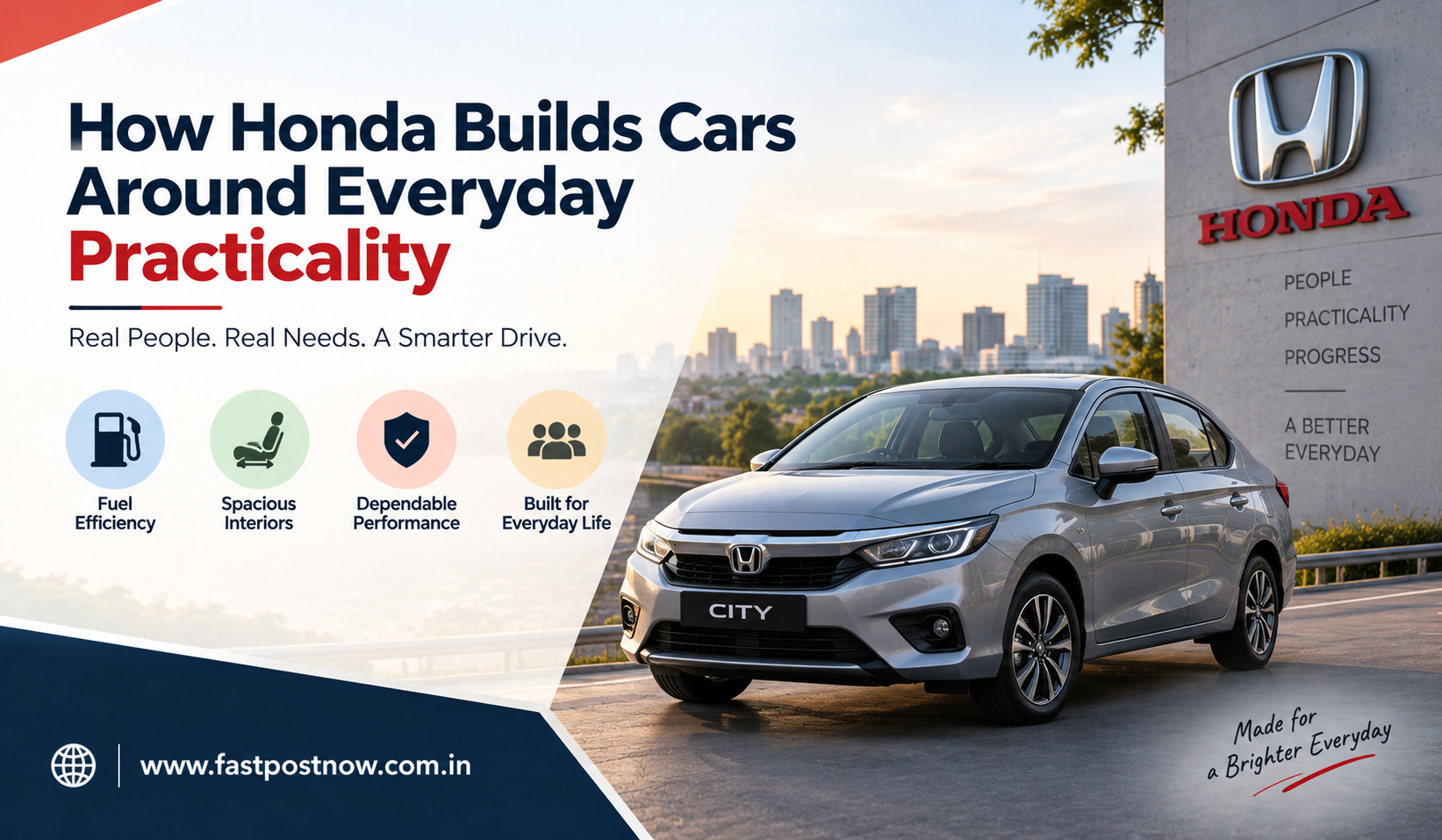
A great car is not always the one with the biggest engine, the longest feature list or the most dramatic design. For many Indian car buyers, what matters more is how effortlessly a vehicle fits into everyday life.
Can it handle crowded city roads? Is it comfortable on long journeys? Can a family carry enough luggage? Is getting in and out easy? Does the car provide useful technology without making the cabin complicated? And, perhaps most importantly, does it remain convenient to live with after the excitement of buying it wears off?
These are the areas where Honda’s approach to car design stands out. Rather than focusing only on headline specifications, Honda has traditionally paid close attention to usability, cabin space, storage, driving comfort and features that make daily journeys easier.
Honda’s current Indian range, including the Honda Amaze, Honda City and Honda Elevate, demonstrates this practical philosophy across different body styles.
Designing Cars Around Real-Life Requirements
Everyday driving in India can be demanding. A car may spend its morning navigating narrow streets, its afternoon sitting in traffic and its weekend covering hundreds of kilometres with passengers and luggage.
Honda’s practical approach begins with understanding these different requirements.
Instead of designing a car exclusively around performance or styling, the company balances several factors: interior space, visibility, storage, ride comfort, boot capacity, fuel efficiency, ease of operation and safety.
This becomes particularly important for family buyers. A specification sheet might tell you an engine’s power output, but it cannot fully explain how convenient the car feels when five people are travelling with luggage.
Honda Amaze: Compact Dimensions, Family-Friendly Thinking
The Honda Amaze is a good example of how practicality can be built into a compact sedan.
Honda’s current Amaze measures 3,995 mm in length, 1,733 mm in width and 1,500 mm in height, with a 2,470 mm wheelbase. The manufacturer lists 416 litres of boot space, giving owners useful room for everyday shopping, luggage and weekend travel.
These numbers matter because compact sedans often need to balance exterior dimensions with interior usability.
Honda has also paid attention to smaller details. The company’s official Amaze material highlights storage provisions such as door bottle holders, front console cup holders, a rear armrest with cup holders and seat-back storage.
These features may not be the first things buyers notice during a showroom visit, but they can become some of the most useful features after months of ownership.
That is the essence of practical design: making small daily tasks easier without demanding attention from the driver.
Honda City: Comfort for Daily Driving and Long Trips
The Honda City takes the same philosophy into the midsize sedan segment.
Honda’s current City is available in petrol and strong-hybrid versions. The petrol model uses a 1.5-litre i-VTEC DOHC engine with VTC, while the hybrid uses Honda’s two-motor e:HEV system. The petrol version is offered with manual and CVT transmission choices, while the e:HEV uses an e-CVT system.
The City also demonstrates Honda’s focus on usable space. Honda’s specifications list a 2,600 mm wheelbase and 510 litres of trunk space for the petrol version.
For families, that combination can be more meaningful than an impressive acceleration figure. A generous boot makes airport runs, family holidays and routine shopping less stressful.
The City’s fuel-efficiency figures also show how Honda considers running costs as part of the ownership experience. Honda lists 17.77 km/l for the petrol manual, 17.97 km/l for the petrol CVT and 27.26 km/l for the e:HEV under its stated test conditions.
Honda Elevate: Practicality in an SUV Package
The Honda Elevate brings the company’s everyday usability philosophy into the SUV segment.
The Elevate uses a 1.5-litre i-VTEC petrol engine and is offered with a six-speed manual or CVT automatic transmission. Honda lists 458 litres of boot space and 220 mm of ground clearance.
That ground clearance can be especially useful for Indian driving conditions, where uneven roads, speed breakers and rough patches are common.
The 458-litre boot also gives the Elevate a practical advantage for families who regularly carry luggage. Combined with the SUV’s seating position and road presence, the result is a vehicle designed not merely to look like an SUV but to support the practical requirements associated with one.
Honda also offers Honda SENSING technology on applicable Elevate variants, including systems such as Collision Mitigation Braking System, Adaptive Cruise Control and Lane Keeping Assist System.
Practicality Is More Than Storage Space
When people talk about a practical car, boot capacity is often the first specification they consider. But true practicality goes much further.
It includes visibility, ergonomics, controls, seating comfort, storage spaces, parking convenience and predictable operation.
A well-designed dashboard means the driver does not have to search for frequently used controls. Comfortable seats reduce fatigue during longer journeys. A good turning radius can make city manoeuvring easier. Parking sensors and cameras can reduce stress in crowded areas.
Honda’s current models show this broader interpretation of practicality by combining physical packaging with technology and convenience features.
Safety as Part of Everyday Usability
Safety should also be considered a fundamental part of practical car design.
A vehicle that is easy to drive but lacks appropriate safety equipment is not truly practical for family ownership.
Honda’s current Indian models incorporate a range of active and passive safety technologies. The Amaze, for example, is advertised by Honda with more than 28 active and passive safety features, including Honda SENSING and six airbags.
The Elevate similarly offers features including six airbags, Vehicle Stability Assist, ABS with EBD, Hill Start Assist, rear parking sensors and Honda SENSING on applicable variants.
The important point is that safety technology becomes most valuable when it works quietly in the background during everyday driving.
Efficiency Without Sacrificing Convenience
Practicality also includes the cost of using a car every day.
Fuel efficiency, transmission choice and maintenance requirements can influence the ownership experience just as much as cabin features.
Honda’s current Indian lineup gives buyers different approaches to efficiency. The City offers petrol and strong-hybrid powertrains, while the Amaze and Elevate focus on petrol powertrains with manual and automatic options depending on the model and variant.
This variety allows buyers to select a car according to how they actually drive rather than forcing every customer into the same solution.
The Bigger Honda Philosophy
Honda’s approach to everyday practicality can ultimately be summed up in one idea: a car should make daily life easier.
That means useful space instead of space that exists only on paper. It means controls that are straightforward to use, storage where occupants need it and technology that serves a purpose. It also means balancing performance, efficiency, comfort and safety rather than maximising one specification at the expense of everything else.
The Amaze demonstrates this philosophy in a compact family sedan. The City extends it into the midsize segment, while the Elevate adapts it to the growing SUV market.
Conclusion: Practicality Is What You Experience Every Day
A car can impress you during a 20-minute test drive, but its real quality becomes apparent after months and years of ownership.
That is why practical design matters.
Honda’s current Indian lineup shows how thoughtful dimensions, useful storage, comfortable cabins, sensible powertrain choices, safety technologies and luggage capacity can combine to create vehicles suited to everyday life.
For Indian families, the best car is often not the one with the most dramatic specification. It is the one that handles school runs, office commutes, traffic jams, shopping trips, weekend journeys and family holidays without making everyday life unnecessarily complicated.
That is where Honda’s focus on everyday practicality becomes its strongest advantage: designing cars not simply for the showroom, but for the thousands of ordinary journeys that come afterwards.

