
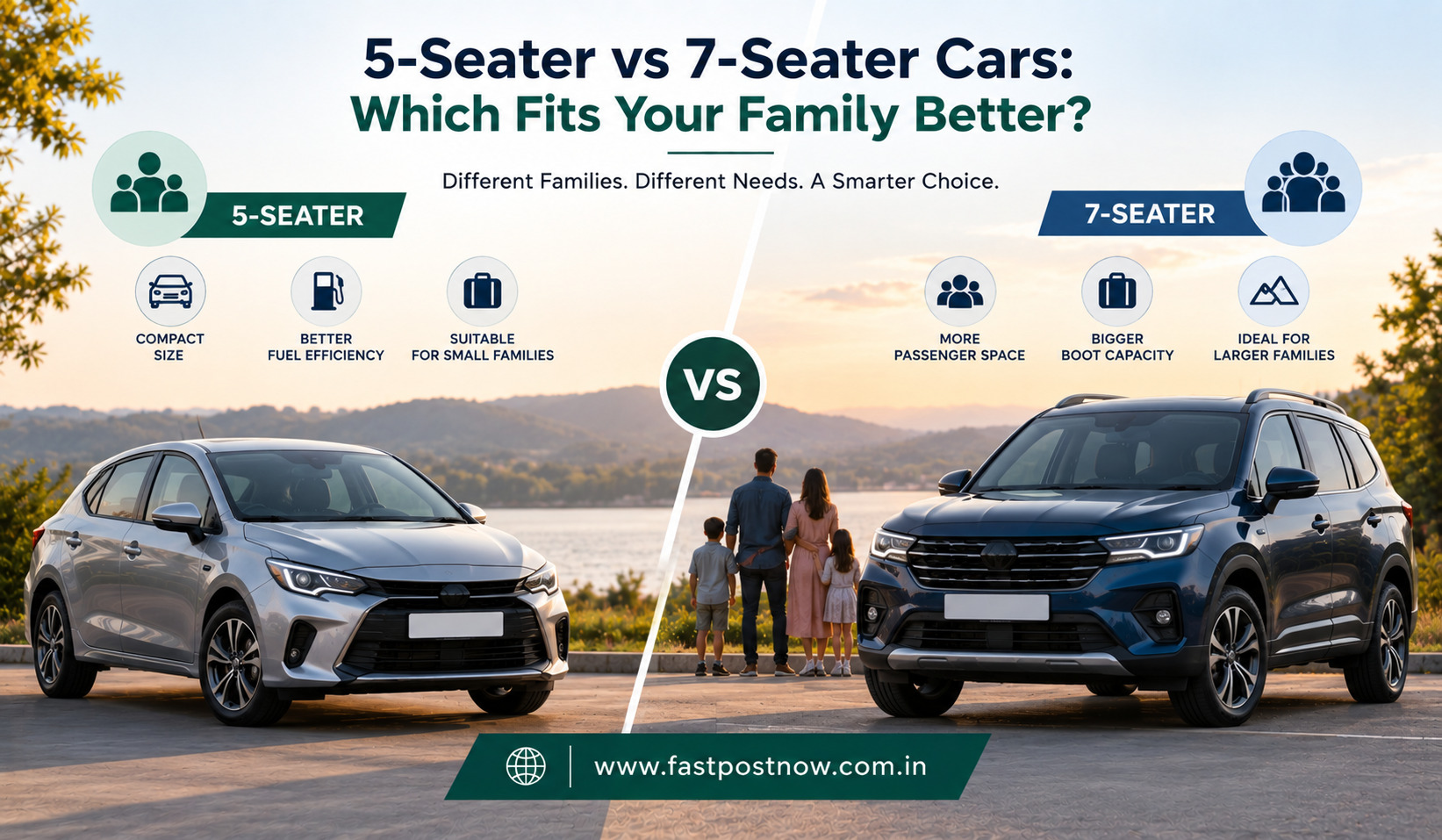
Choosing the right family car is not simply about selecting the newest model or the biggest vehicle. One of the first decisions buyers need to make is whether a 5-seater or 7-seater car is more suitable for their family. Both options can provide comfort, useful features and practical everyday transportation, but they are designed for different passenger requirements.
A 5-seater can be easier to manage in city traffic and may provide a better balance between passenger space, luggage capacity and running costs. A 7-seater, meanwhile, gives families additional seating flexibility and becomes particularly useful when grandparents, children, relatives or friends frequently travel together.
Current Indian models demonstrate the difference clearly. The Hyundai CRETA is a five-seat SUV, while the Hyundai ALCAZAR is available in both six- and seven-seat configurations. Kia’s current Carens Clavis also offers a seven-seat configuration.
So, which one makes more sense for your family?
5-Seater Cars Are Often Easier for Daily Driving
For families that normally have four or five occupants, a 5-seater can be the simpler choice.
A typical five-seat layout provides two seats in the front and a three-person rear bench. This arrangement leaves the entire rear section of the vehicle available for passengers and luggage without requiring a separate third row.
The Hyundai CRETA, for example, is officially listed as a five-seater and uses a 60:40 split rear seat. This gives occupants seating for five while also allowing the rear seatbacks to be folded when additional cargo space is required.
For a small family, this straightforward layout can be more practical than carrying an unused third row every day.
7-Seater Cars Provide Extra Flexibility
The biggest advantage of a 7-seater is obvious: more people can travel in the same vehicle.
This can be valuable for joint families or households where grandparents and children regularly travel together. It can also help when you frequently have guests or need to transport additional passengers during weekend trips.
The Hyundai ALCAZAR is currently available in both 6-seat and 7-seat configurations. Its 7-seat version uses a 60:40 split second row and a 50:50 split third row, with the third row also offering reclining functionality.
The Kia Carens Clavis also offers a 7-seat layout, with a 60:40 split second row and 50:50 split third row that can recline and fold flat.
This flexibility can be extremely useful when passenger requirements change from one trip to another.
Consider How Often You Actually Carry Seven People
A common mistake is buying a 7-seater simply because it appears more practical.
If your family almost always consists of two adults and one or two children, a five-seater may already provide enough room. The additional seats of a 7-seater might remain unused most of the time.
On the other hand, if you regularly carry six or seven people, a five-seater can become inconvenient very quickly.
Think about your normal week rather than occasional situations. If seven people travel together only once or twice a year, you might prefer a 5-seater and use another solution for those rare journeys. If seven occupants are common, the extra seats can justify choosing a larger vehicle.
Third-Row Comfort Matters More Than the Seat Count
Seeing “7-seater” on a specification sheet does not automatically mean that seven adults will be equally comfortable.
Third-row design varies significantly between vehicles. Legroom, headroom, seat height, access, ventilation and seat cushioning all influence how comfortable passengers will be.
The ALCAZAR, for example, has height-adjustable headrests across all three rows, a sliding and reclining second row and a 50:50 split third row.
The Carens Clavis similarly provides three-row seating, second-row sliding, reclining and tumble functionality, along with reclining and folding third-row seats.
Families should therefore sit in the third row before buying. This is particularly important if adults or teenagers will regularly use those seats.
A 5-Seater Can Offer Better Everyday Cargo Flexibility
When all seats are occupied, luggage space becomes an important consideration.
A five-seater has a major advantage because there is no third row occupying the rear section of the cabin. With five occupants inside, the luggage compartment remains available for everyday bags, groceries and travel luggage.
A seven-seater has to divide its interior between passenger seating and cargo space. When all three rows are in use, the available luggage area can be more limited depending on the model.
However, modern 7-seaters compensate with folding third-row seats. The Carens Clavis, for example, has a 50:50 split third row that can recline and fold flat.
This means you can convert part of the passenger area into additional cargo space when fewer people are travelling.
7-Seaters Are Useful for Family Road Trips
Long-distance travel is one situation where a 7-seater can become particularly valuable.
Imagine travelling with two parents, two children and three grandparents. A 5-seater simply cannot accommodate everyone legally and comfortably. A 7-seater allows the entire group to travel together.
Three-row vehicles can also be useful during family functions, airport transfers and weekend outings where passenger numbers change frequently.
Features designed around family travel can make a difference too. The current ALCAZAR offers rear air-conditioning vents serving the second and third rows, while Kia’s Carens Clavis includes roof-mounted air vents for the second and third rows.
These details become more important when several people spend hours inside the car.
City Driving Can Favour a 5-Seater
For someone who spends most of the week driving through crowded urban roads, a five-seater may be easier to live with.
The vehicle does not need to be as focused on accommodating a third row, and parking, turning and everyday manoeuvring can feel simpler depending on the model.
That does not mean every 7-seater is difficult to drive. Modern three-row vehicles are designed for urban use as well as highway travel. However, buyers should consider the vehicle’s overall dimensions and whether their regular parking space can accommodate it comfortably.
The best approach is to test-drive the actual model in conditions similar to your daily routine.
Engine Choices Can Also Influence Your Decision
Seating capacity is only one part of choosing a family vehicle. Engine and transmission options can affect how well the car matches your driving style.
The Hyundai CRETA currently offers a 1.5-litre naturally aspirated petrol engine, a 1.5-litre diesel and a 1.5-litre turbo-petrol engine, with different transmission options depending on the variant.
The ALCAZAR currently offers 1.5-litre turbo-petrol and 1.5-litre diesel engines, with manual, automatic and DCT choices depending on the variant.
Kia’s Carens Clavis is also offered with multiple 1.5-litre petrol and diesel powertrain combinations, depending on the variant.
Instead of assuming a larger vehicle needs a particular type of engine, compare the powertrain options with your expected city and highway usage.
Think About Your Family’s Growth
Your current family size is important, but future requirements also deserve consideration.
A couple with one child may find a 5-seater perfect today. However, if they expect to regularly travel with grandparents or additional family members, a 7-seater could provide useful flexibility for several years.
At the same time, buying a larger vehicle solely for a possible future requirement may not always be financially sensible.
Consider how long you expect to keep the car and whether your family situation is likely to change significantly during that period.
Safety Should Come Before Seating Capacity
Whether you choose five seats or seven, safety should remain a priority.
Look beyond the number of airbags and examine the complete safety package, including electronic stability control, braking systems, parking assistance, child-seat compatibility and available driver-assistance technologies.
For example, Hyundai’s current CRETA feature list includes six airbags, ABS with EBD, Electronic Stability Control and Vehicle Stability Management.
The ALCAZAR’s current equipment list includes safety and driver-assistance features that vary by variant.
Always check the exact safety equipment of the variant you intend to purchase rather than assuming that every feature is standard across the entire model range.
Which Is More Economical?
A 5-seater can potentially be the more economical choice because you may not need to pay for the additional size and equipment associated with a larger three-row vehicle.
But the price difference between individual models varies considerably. Insurance, fuel consumption, maintenance, tyres and financing costs should all be considered alongside the initial purchase price.
A 7-seater can offer better value if it eliminates the need for a second family vehicle or frequent alternative transportation when several people need to travel together.
Therefore, “cheaper” does not always mean “better value.” Consider how much you will actually use the additional seating.
5-Seater vs 7-Seater: Which One Should You Buy?
A 5-seater car is generally the better fit if your household normally travels with up to five people and you prioritise easy daily use, straightforward luggage management and city-friendly practicality.
A 7-seater car makes more sense when you frequently travel with larger groups, have grandparents or extended family at home, take regular family road trips or simply want additional seating flexibility.
The Hyundai CRETA represents the current five-seat family-SUV approach, while models such as the Hyundai ALCAZAR and Kia Carens Clavis demonstrate how modern three-row vehicles can combine passenger capacity with flexible seating arrangements.
Final Verdict
There is no universal winner between a 5-seater and a 7-seater car. The best option depends on how frequently you carry passengers, how much luggage you normally transport and how often your family travels together.
If five seats comfortably cover your everyday needs, a 5-seater can be the smarter and simpler choice. But if carrying additional family members is a regular part of your life, the flexibility of a 7-seater can be worth the extra size and cost.
Before making the final decision, take the whole family for a test drive. Sit in every row, check luggage requirements, try entering and exiting the third row and consider your normal driving conditions. A car becomes truly practical when its seating, space and features match the way your family actually travels.