
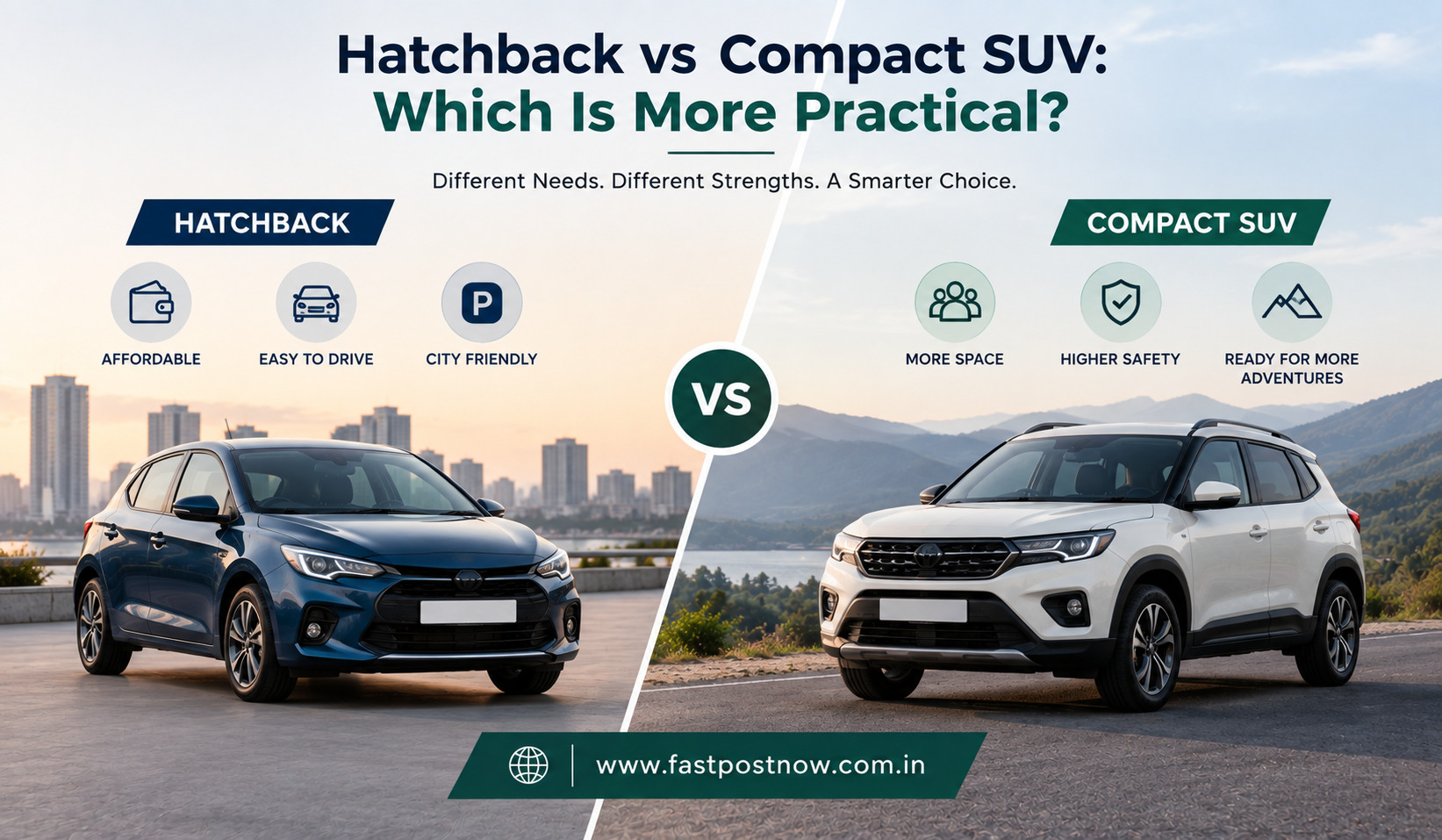
Choosing between a hatchback and a compact SUV can be surprisingly difficult for Indian car buyers. Both body styles can work well for daily commuting, family use and occasional highway trips, but they approach practicality in different ways. A hatchback usually focuses on compact dimensions, easy manoeuvrability and efficient use of space, while a compact or sub-compact SUV generally adds a taller stance, higher seating position and greater road presence.
The right choice depends less on which body style looks better and more on how you actually use your car. For some drivers, a hatchback remains the smarter urban vehicle. For others, an SUV’s extra height and versatile character can make everyday driving easier.
The Hyundai i20 and Hyundai Venue provide useful current-market examples. Hyundai currently lists the i20 as a hatchback and the Venue as a sub-compact SUV in India.
Size and City Manoeuvrability
One of the biggest advantages of a hatchback is its compact footprint. Smaller dimensions can make it easier to drive through crowded streets, narrow lanes and busy parking areas.
The current Hyundai i20 measures 3,995 mm in length and 1,775 mm in width. Its 2,580 mm wheelbase provides a useful balance between cabin space and urban manoeuvrability.
The current Hyundai Venue has the same 3,995 mm overall length but is wider at 1,800 mm and taller at 1,665 mm, with a 2,520 mm wheelbase.
This means the two vehicles occupy a similar length category, but the Venue’s taller and wider body gives it a more SUV-like character.
For drivers who regularly deal with narrow parking spaces or congested residential streets, the hatchback can feel easier to place on the road. The SUV, however, may provide a more commanding view from the driver’s seat.
Ground Clearance and Indian Roads
Indian roads can present everything from smooth expressways to poorly surfaced streets, steep ramps and large speed breakers. This is an area where SUVs generally have an advantage.
The Hyundai i20 has an official ground-clearance figure of 170 mm.
The higher stance of an SUV can provide additional confidence when approaching uneven roads and obstacles. However, higher ground clearance should not be interpreted as permission to drive over rough terrain aggressively. Suspension setup, tyres, wheel size and driving technique also affect how comfortably a car handles poor roads.
For someone living in an area with frequent broken roads or large speed breakers, the SUV format can therefore be more convenient.
Cabin Space and Seating Comfort
A hatchback does not automatically mean a cramped cabin. Modern hatchbacks can make efficient use of their wheelbase and interior layout.
The Hyundai i20, for example, has a 2,580 mm wheelbase, which contributes to usable passenger space despite its hatchback dimensions.
Compact SUVs tend to create a different feeling because passengers sit higher from the road. The taller body can make getting into and out of the vehicle feel easier for some occupants.
The Venue’s 2,520 mm wheelbase is actually shorter than the i20’s, so buyers should not assume that every SUV automatically offers more legroom. Interior space depends on seat design, dashboard packaging, rear-seat layout and available headroom.
This is an important point when comparing cars: body style alone does not determine cabin space.
Boot Space and Everyday Storage
Boot practicality is another area worth considering. Hatchbacks typically provide a rear cargo area that opens through the large tailgate, making them useful for groceries, backpacks, office bags and smaller family luggage.
A compact SUV can provide a similarly practical luggage area while giving the vehicle a taller overall structure. Depending on the model, this can make loading and unloading certain items more convenient.
However, buyers should compare the actual boot layout rather than choosing based solely on the SUV label. A well-designed hatchback can be more useful for a particular family than a larger-looking SUV.
If your typical requirement is two or three shopping bags and occasional luggage, a hatchback may already provide everything you need.
Fuel Efficiency and Running Costs
Fuel economy can strongly influence the long-term cost of owning a car.
A smaller hatchback is often designed around efficient urban transportation, with relatively compact dimensions and engines intended for everyday commuting. The Hyundai i20 currently uses a 1.2-litre Kappa petrol engine, with 5-speed manual and IVT transmission options depending on the variant.
The Venue offers a wider powertrain range. Hyundai currently lists a 1.2-litre naturally aspirated petrol engine, a 1.0-litre turbo-petrol engine and a 1.5-litre diesel engine for the Venue lineup.
A broader engine lineup can be useful because buyers can select a powertrain according to their driving requirements. However, a larger or more powerful SUV configuration may not always deliver the same running-cost profile as a smaller hatchback.
For a person whose main priority is economical daily commuting, comparing real-world fuel consumption and maintenance costs should be part of the buying decision.
Highway Driving
The choice becomes more interesting when highway use is included.
Hatchbacks can be perfectly capable highway cars. Their lower body and compact dimensions can make them easy to drive, and a well-engineered hatchback can remain stable and comfortable at highway speeds.
Compact SUVs offer a different experience. Their taller driving position can provide a better view of surrounding traffic, while some models offer more powerful engine choices.
The Hyundai Venue, for example, offers a 1.0-litre turbo-petrol and 1.5-litre diesel option in addition to its 1.2-litre petrol engine.
For buyers who frequently travel long distances, the availability of multiple engine choices can make a compact SUV attractive. Nevertheless, highway comfort depends on much more than body style, including seats, suspension, tyres, engine performance and cabin insulation.
Parking and Daily Convenience
Parking is one area where hatchbacks have a natural advantage.
Their compact shape can make it easier to judge the front and rear ends of the vehicle in tight spaces. This is especially useful for new drivers or people who frequently park in older buildings with narrow parking areas.
A sub-compact SUV can still be easy to park, particularly when equipped with parking sensors and a camera, but its wider and taller body may require a little more awareness.
The current Venue measures 1,800 mm in width, compared with 1,775 mm for the i20.
That 25 mm difference may look small on paper, but the driver’s perception of vehicle width can matter in narrow parking spaces.
Visibility and Driving Position
This is where many SUV buyers immediately notice a difference.
SUVs generally offer a higher seating position, which can make drivers feel more confident when looking over surrounding traffic. The Venue’s taller body gives it a noticeably more upright SUV stance. Hyundai lists its height at 1,665 mm, compared with 1,505 mm for the i20.
The hatchback’s lower seating position can appeal to drivers who prefer a more car-like driving feel.
Neither position is universally better. Some drivers prefer the lower centre of gravity and familiar driving position of a hatchback, while others appreciate the elevated view from an SUV.
Purchase Price and Value
Price is another important part of practicality.
A hatchback generally occupies a lower price range than many SUVs, although the gap varies considerably between brands and models. This means a hatchback can leave more money available for insurance, accessories, fuel or future maintenance.
A compact SUV may justify a higher purchase price for buyers who value its additional features, taller stance, road presence and versatility.
The important question is whether you will actually use those advantages. Paying extra for an SUV only to drive short distances alone through city traffic may not provide the best value.
Which Is Better for Families?
For a small family, either body style can work.
A hatchback can be practical for parents who mainly drive children to school, commute to work and handle everyday shopping. Its compact dimensions can be particularly useful in crowded urban areas.
A compact SUV can be preferable for families that regularly travel with several passengers, take highway trips or encounter uneven roads.
Families should also consider rear-seat comfort, child-seat compatibility, door opening angles, luggage requirements and ease of getting in and out before making a decision.
Which Is Better for New Drivers?
New drivers often benefit from a car that is easy to understand and manoeuvre.
A hatchback’s compact footprint can make it less intimidating in traffic and easier to position in parking spaces. This can be especially useful when learning to judge the vehicle’s corners.
An SUV’s higher seating position can improve the driver’s view, but the greater width and taller body may initially require additional awareness.
A test drive in familiar traffic conditions is therefore more useful than relying only on specifications.
Hatchback vs Compact SUV: Which Should You Choose?
There is no single winner because practicality depends on the driver’s priorities.
Choose a hatchback if you mainly want easy city driving, simple parking, compact dimensions and efficient everyday transportation. It can be an excellent option for individuals, couples and small families who spend most of their time in urban environments.
Choose a compact or sub-compact SUV if you prefer a higher driving position, need greater confidence on uneven roads, regularly travel with family or want a more versatile vehicle for mixed city and highway use.
The Hyundai i20 and Hyundai Venue demonstrate how two vehicles with similar overall lengths can provide distinctly different experiences. The i20 is lower and narrower, while the Venue provides a taller and wider SUV-style body. Both remain current models in Hyundai India’s lineup.
Final Verdict
For pure urban practicality, a good hatchback remains difficult to beat. It is compact, easy to manoeuvre and can meet the needs of many daily commuters without unnecessary size.
A compact SUV becomes more practical when higher seating, additional road clearance, family versatility and mixed-road use matter more.
Instead of choosing a vehicle simply because SUVs are popular, consider your daily route, parking conditions, passenger requirements, luggage needs and annual driving distance. The most practical car is ultimately the one that fits your routine rather than the one with the most fashionable body style.