
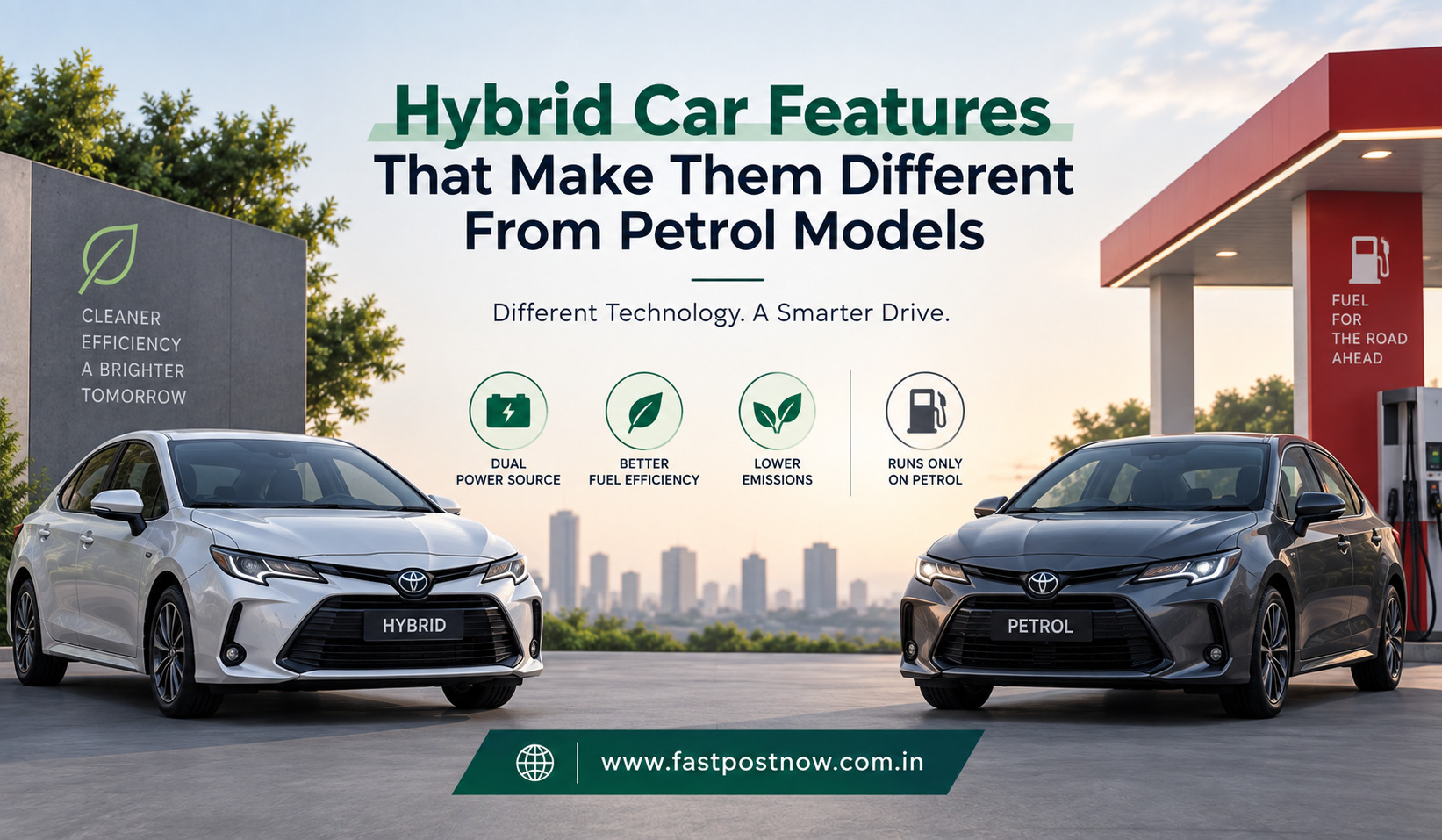
Hybrid cars have changed the way many drivers think about everyday petrol-powered mobility. While a conventional petrol car relies primarily on an internal combustion engine, a hybrid car combines a petrol engine with an electric motor and battery system. This combination allows the vehicle to use electric power in situations where a traditional petrol engine may be less efficient.
In India, hybrid technology is becoming increasingly visible in cars such as the Toyota Urban Cruiser Hyryder, Maruti Suzuki Grand Vitara, Toyota Innova HyCross and Honda City e:HEV. These models show how hybrid systems can improve efficiency while retaining the convenience of petrol fuel. But what exactly makes hybrid cars different from conventional petrol models?
Hybrid Cars Use Two Power Sources
The biggest difference is the powertrain itself. A conventional petrol car uses an internal combustion engine as its main source of propulsion. Fuel is burned inside the engine to generate the power needed to move the vehicle.
A hybrid car adds an electric motor and a high-voltage battery to this setup. Depending on the type of hybrid system, the car can operate using the petrol engine, the electric motor, or a combination of both.
For example, Toyota describes the Urban Cruiser Hyryder’s strong-hybrid system as a self-charging setup that combines a 1.5-litre petrol engine with Toyota’s hybrid technology. The Hyryder’s hybrid version uses an e-drive transmission and is rated at up to 27.97 km/l under certified test conditions.
This ability to switch between power sources is one of the most important features separating a hybrid from a conventional petrol car.
Electric Driving Becomes Possible
A conventional petrol car generally needs its engine running whenever it is moving. A strong hybrid, however, can use electric power for certain driving conditions.
This is particularly useful during low-speed driving, gentle acceleration and some urban situations. The electric motor can move the vehicle without requiring the petrol engine to operate continuously.
The Maruti Suzuki Grand Vitara Strong Hybrid, for instance, uses an electric motor and lithium-ion battery alongside its petrol engine and provides an EV driving mode. Maruti Suzuki has also highlighted the ability of its strong-hybrid technology to spend a significant portion of city driving in EV mode.
This can make a hybrid feel noticeably different from a petrol car in stop-and-go traffic.
Regenerative Braking Helps Recharge the Battery
Another major hybrid feature is regenerative braking. In a conventional petrol car, much of the energy created while slowing down is lost as heat through the braking system.
Hybrid vehicles can recover some of this energy. When the vehicle slows down, the electric motor can work as a generator, converting part of the vehicle’s kinetic energy into electrical energy. That energy is then stored in the hybrid battery for later use.
The process happens automatically while driving, so the driver does not normally need to plug the vehicle into a charger or manually recharge the battery.
This is why strong hybrids sold in India are often described as self-charging hybrids. The Toyota Urban Cruiser Hyryder, for example, does not require an external charging connection for its hybrid battery.
Better Fuel Efficiency Is a Major Advantage
Fuel efficiency is one of the main reasons buyers consider hybrid cars. Because the electric motor can assist the petrol engine and take over some driving duties, the engine does not have to do all the work.
The difference can be especially noticeable in urban traffic, where frequent acceleration, deceleration and idling can reduce the efficiency of a conventional petrol vehicle.
The Toyota Urban Cruiser Hyryder Strong Hybrid is officially rated at 27.97 km/l under certified conditions. The Maruti Suzuki Grand Vitara Strong Hybrid carries the same 27.97 km/l certified efficiency figure.
These figures are laboratory-certified figures rather than guarantees of real-world mileage. Actual fuel economy depends on traffic, driving style, road conditions, temperature, vehicle load and other factors.
Petrol Engine Operation Can Be Reduced
Hybrid technology can reduce the amount of time the petrol engine needs to operate. When the vehicle stops at traffic lights or remains stationary in suitable conditions, the engine can automatically shut down.
When additional power is required, the system can restart the engine without requiring the driver to operate a separate control.
The Honda City e:HEV illustrates this approach. Honda lists an automatic engine stop/start system as part of its hybrid powertrain and combines a 1.5-litre Atkinson-cycle petrol engine with an electric traction motor.
This is different from the driving experience of a traditional petrol car, where the engine is generally the central source of propulsion throughout the journey.
Hybrid Cars Can Feel Smoother in Traffic
Electric motors produce torque quickly, which can give hybrid cars a smooth response when moving away from a standstill. The petrol engine can then provide additional power when required.
The result can be a quieter and more seamless driving experience, particularly at lower speeds. Toyota says the Urban Cruiser Hyryder’s self-charging hybrid system can provide a smooth and quiet drive while using electric power.
The exact driving character varies between hybrid systems. Some hybrids prioritize electric operation, while others frequently combine engine and motor power.
Hybrid Transmissions Work Differently
A hybrid car may not use the same transmission arrangement as a conventional petrol car.
The Toyota Urban Cruiser Hyryder Strong Hybrid uses an e-drive transmission, while the Maruti Suzuki Grand Vitara Strong Hybrid uses an e-CVT. Honda’s City e:HEV uses an electrically coupled e-CVT with an engine-linked clutch.
This means the driving sensation can differ from that of a traditional manual, torque-converter automatic or dual-clutch petrol car. In many situations, the system prioritizes smooth power delivery rather than traditional gear changes.
The Hybrid Battery Is an Important Component
A hybrid vehicle needs a battery powerful enough to store and deliver electrical energy. Strong hybrids generally use a high-voltage battery pack, rather than the small 12-volt battery found in conventional cars for starting and electrical accessories.
Honda’s City e:HEV, for example, uses an advanced high-voltage lithium-ion battery with a nominal voltage of 172.8 volts.
Because the hybrid battery is an integral part of the powertrain, buyers should also pay attention to the manufacturer’s battery warranty and maintenance terms before purchasing a hybrid.
Hybrids Do Not Need Regular Plug-In Charging
One common misunderstanding is that every hybrid needs to be connected to a charger. That is not true for self-charging strong hybrids available in India’s mainstream market.
The Toyota Urban Cruiser Hyryder Strong Hybrid and Honda City e:HEV are designed to recharge their hybrid batteries through the vehicle’s own systems, including regenerative braking and engine-generated electrical energy. Honda specifically identifies the City e:HEV as a self-charging strong hybrid that is not externally chargeable.
This gives hybrid owners an experience closer to owning a petrol car in terms of refuelling convenience while still benefiting from electric assistance.
Hybrid Cars Can Reduce Petrol Consumption in City Driving
For drivers who spend considerable time in crowded urban traffic, hybrid technology can be particularly useful. Frequent stops give the hybrid system more opportunities to recover energy through regenerative braking, while low-speed driving can allow greater use of the electric motor.
A conventional petrol car can still be highly efficient, but it cannot independently drive using stored electrical energy in the same way as a strong hybrid.
This makes the hybrid powertrain especially interesting for people who regularly commute through busy cities.
Hybrid and Petrol Cars Still Have Some Similarities
Despite these differences, hybrid cars are not completely separate from petrol vehicles. Strong hybrids still use petrol engines, fuel tanks and conventional refuelling infrastructure.
For example, the Toyota Innova HyCross is available with both hybrid and petrol powertrains. Toyota’s hybrid version uses a 2.0-litre petrol engine with its fifth-generation self-charging hybrid system and e-drive transmission, while petrol versions use a 2.0-litre engine with a direct-shift CVT.
This makes hybrids an interesting middle ground between conventional petrol vehicles and fully electric cars.
Are Hybrid Cars Better Than Petrol Cars?
There is no universal answer because the better choice depends on how the car will be used.
A conventional petrol car can make sense for buyers who prioritize a simpler powertrain, lower initial purchase cost or mostly drive on highways. A hybrid can be more attractive to people who frequently drive in cities and want better fuel efficiency without depending on external charging.
Hybrid cars can also offer a quieter and smoother low-speed driving experience. However, their technology is more complex, and strong-hybrid versions can cost more than comparable petrol variants.
Final Thoughts
The biggest difference between a hybrid car and a conventional petrol model is the way energy is managed. Instead of relying entirely on petrol, a hybrid combines an internal combustion engine, electric motor and battery to improve efficiency and driving smoothness.
Features such as regenerative braking, electric driving, automatic engine stop-start, self-charging capability and intelligent power management give hybrids a distinct advantage in many urban driving situations.
Current Indian models such as the Toyota Urban Cruiser Hyryder, Maruti Suzuki Grand Vitara, Toyota Innova HyCross and Honda City e:HEV demonstrate that hybrid technology is no longer limited to niche vehicles. For buyers who want the convenience of petrol refuelling with some of the efficiency benefits of electric propulsion, a hybrid can offer a practical alternative.