
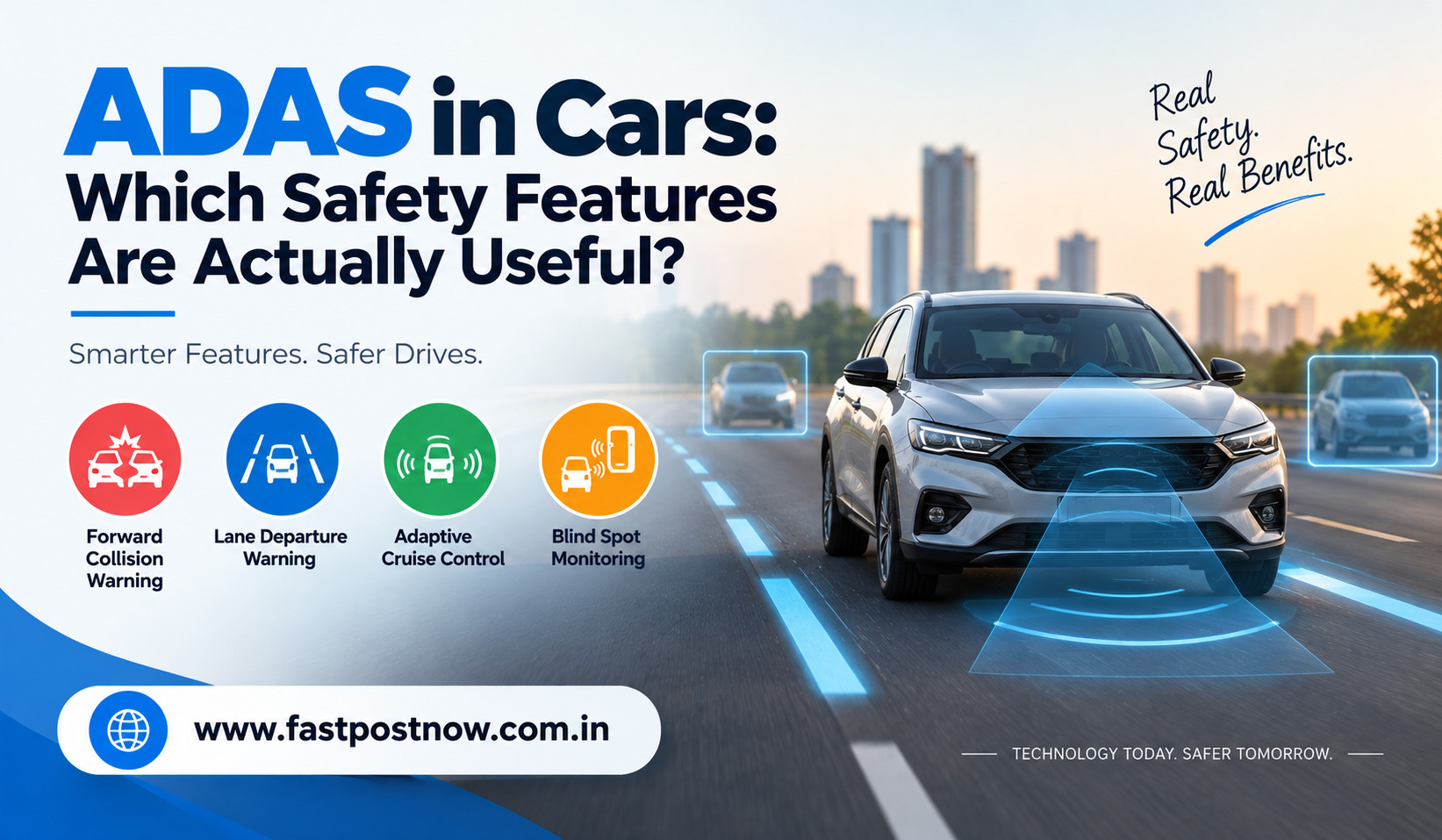
Modern cars are becoming smarter, but not every advanced feature deserves equal attention. When shopping for a new vehicle, you may see terms such as Forward Collision Warning, Lane Keeping Assist, Blind-Spot Monitoring, Adaptive Cruise Control and Automatic Emergency Braking. Together, these technologies are generally grouped under Advanced Driver Assistance Systems, or ADAS.
ADAS is designed to support the driver by monitoring the road, identifying potential hazards and, in some situations, helping with steering, braking or acceleration. However, having a long list of ADAS features does not automatically mean a car is safer in every situation.
For buyers in India, the more important question is: Which ADAS features are actually useful in everyday driving?
The answer depends on where and how you drive, but some systems have clear practical benefits.
What Is ADAS in Cars?
Advanced Driver Assistance Systems use technologies such as cameras, radar, sensors and software to monitor the vehicle’s surroundings.
Depending on the car, ADAS can provide warnings when a collision appears likely, assist with lane positioning, monitor blind spots or maintain a set distance from another vehicle.
Some systems only warn the driver, while others can temporarily intervene by applying the brakes or making small steering adjustments.
ADAS should not be confused with autonomous driving. Even advanced Level 2 systems still require the driver to remain attentive and responsible for controlling the vehicle.
The current Hyundai CRETA, for example, offers Hyundai SmartSense Level 2 ADAS with features covering collision avoidance, lane safety, blind-spot assistance and adaptive cruise control.
1. Forward Collision Warning Is One of the Most Useful Features
Forward Collision Warning (FCW) monitors the road ahead and can alert the driver when the vehicle appears to be approaching another vehicle or obstacle too quickly.
This can be especially useful in heavy traffic. A driver may become distracted for a moment, fail to notice that traffic has slowed or misjudge the distance from the vehicle ahead.
An early warning can bring attention back to the road.
FCW is particularly useful because it addresses one of the most common driving situations: failing to react quickly enough to something directly ahead.
However, FCW generally provides a warning rather than physically stopping the car. Its effectiveness therefore depends on the driver responding appropriately.
2. Automatic Emergency Braking Can Be Even More Valuable
Automatic Emergency Braking (AEB), often included within a manufacturer’s forward-collision avoidance system, can go beyond simply warning the driver.
If the system detects an imminent collision and determines that the driver has not reacted sufficiently, it may automatically apply the brakes.
Depending on the vehicle, the system can be designed to recognise cars, pedestrians, cyclists or other road users.
Hyundai’s current CRETA, for example, lists Forward Collision-Avoidance Assist for cars, pedestrians and cyclists, along with additional collision-avoidance functions.
For Indian roads, collision-avoidance technology that can recognise vulnerable road users can be particularly valuable because urban traffic often includes pedestrians, motorcycles and cyclists.
3. Lane Departure Warning Helps When Attention Slips
Lane Departure Warning (LDW) alerts the driver when the car appears to unintentionally move out of its lane.
It can be useful on highways and other roads with clearly visible lane markings.
Fatigue, distraction or a brief lapse in concentration can cause a vehicle to drift. An audible, visual or steering-wheel warning can remind the driver to correct the vehicle’s position.
LDW is a warning system, so it does not necessarily steer the car back into position.
For buyers comparing ADAS packages, it is useful to distinguish LDW from Lane Keeping Assist, which can provide steering intervention.
4. Lane Keeping Assist Adds Active Support
Lane Keeping Assist (LKA) can provide steering assistance when the vehicle begins to leave its lane unintentionally.
This can be particularly helpful during long highway journeys, when driver fatigue can gradually affect concentration.
The current Hyundai CRETA includes Lane Keeping Assist within its SmartSense Level 2 ADAS package.
However, LKA should never encourage drivers to stop paying attention. Road markings can disappear, construction zones can confuse sensors and unusual road layouts may affect system performance.
Think of LKA as an additional layer of assistance, not a replacement for steering control.
5. Blind-Spot Monitoring Is Highly Practical
Blind-Spot Monitoring can be one of the most useful ADAS technologies for everyday driving.
When another vehicle enters an area that may be difficult to see using conventional mirrors, the system can provide a visual warning.
This can be particularly helpful when changing lanes on multi-lane roads.
Some advanced systems can go beyond warning the driver and provide steering or braking assistance if a collision risk is detected.
Hyundai’s current CRETA offers Blind-Spot Collision Warning and Blind-Spot Collision Avoidance Assist on applicable variants.
For drivers who frequently deal with busy highways and dense traffic, this is an ADAS feature worth prioritising.
6. Rear Cross-Traffic Alert Helps When Reversing
Reversing out of a parking space can be surprisingly difficult.
A vehicle parked next to you may block your view of approaching traffic. Motorcycles, pedestrians and other cars can appear from the sides just as you begin reversing.
Rear Cross-Traffic Alert monitors areas behind and beside the vehicle and can warn the driver when cross traffic is approaching.
Some advanced systems can also apply the brakes automatically.
Kia’s current Seltos specification lists Rear Cross-Traffic Collision Warning and Rear Cross-Traffic Collision-Avoidance Assist among its safety technologies.
This makes the feature especially relevant for city drivers who regularly use crowded parking areas.
7. Adaptive Cruise Control Is Most Useful on Highways
Adaptive Cruise Control (ACC) automatically adjusts the vehicle’s speed to maintain a selected distance from traffic ahead.
Unlike conventional cruise control, it can slow down when traffic becomes slower and accelerate again when the road clears, depending on the system.
It can reduce driver workload during long highway journeys.
However, ACC is generally less useful in chaotic stop-and-go city traffic where motorcycles, pedestrians and frequent lane changes can make conditions unpredictable.
The current Hyundai CRETA offers Smart Cruise Control with Stop & Go on applicable variants.
For someone who mostly drives in cities, features such as AEB, blind-spot monitoring and parking assistance may provide more everyday value than adaptive cruise control.
8. Driver Attention Warning Can Catch Fatigue
Driver Attention Warning (DAW) is designed to identify signs that may indicate reduced driver attention or fatigue.
The system can analyse driving behaviour and other inputs and may recommend taking a break when it detects patterns associated with inattentive driving.
This can be useful during long journeys.
It is not a medical fatigue detector and cannot determine exactly how tired a person is. The driver should always make the final decision about whether to stop and rest.
Hyundai’s current CRETA SmartSense package includes Driver Attention Warning.
9. High Beam Assist Is Simple but Useful
Not every valuable ADAS feature has to be complicated.
High Beam Assist can automatically switch between high and low beams depending on detected traffic conditions.
This can reduce the chance of accidentally leaving high beams on when another vehicle approaches.
It can also reduce the need for the driver to repeatedly adjust the lights on dark roads.
Hyundai lists High Beam Assist among the SmartSense technologies available on the current CRETA.
10. Safe Exit Warning Can Protect Passengers
A less familiar feature is Safe Exit Warning.
It can warn occupants when they are about to open a door while another vehicle or road user is approaching from behind.
This can be particularly useful when parking alongside busy streets.
A passenger opening a door without checking can create a dangerous situation for passing motorcycles, cyclists or vehicles.
Hyundai’s current CRETA feature list includes Safe Exit Warning within its ADAS technology on applicable variants.
11. Traffic Sign Recognition Can Be Helpful, But It Has Limits
Traffic Sign Recognition uses cameras to identify certain road signs and display relevant information to the driver.
It can be useful when drivers miss a speed-limit sign or travel through unfamiliar areas.
However, Indian roads can contain temporary signs, inconsistent markings and signs that may be partially obscured. Therefore, this technology should be considered a convenience and awareness aid rather than an authority that always knows the current road rules.
12. 360-Degree Cameras Are Not Exactly ADAS, But They Matter
A 360-degree camera is often marketed alongside ADAS even though it is primarily a visibility and parking assistance system.
It creates a top-down-style view around the vehicle using multiple cameras.
For city driving, this can be extremely useful when navigating narrow parking spaces, basement garages or crowded areas.
The current Hyundai CRETA offers a Surround View Monitor and Blind-Spot View Monitor.
These systems can reduce blind areas around the vehicle, but drivers should still check their surroundings directly.
Which ADAS Features Should You Prioritise?
If safety is your main reason for choosing ADAS, not every feature needs to carry equal weight.
For most drivers, the most useful technologies are:
Forward Collision Warning and Automatic Emergency Braking: Useful for detecting potential frontal crashes and providing an additional response when the driver does not react quickly enough.
Blind-Spot Monitoring: Particularly useful when changing lanes in busy traffic.
Lane Departure Warning and Lane Keeping Assist: Valuable on highways and during long journeys.
Rear Cross-Traffic Alert: Helpful when reversing out of parking spaces.
Driver Attention Warning: Useful for people who frequently undertake long drives.
Adaptive Cruise Control: Most valuable for regular highway travel rather than crowded urban roads.
360-degree cameras: Extremely practical for parking and manoeuvring, although they are not a substitute for direct observation.
ADAS Is Not a Substitute for Safe Driving
The biggest mistake a driver can make is becoming overconfident because the car has ADAS.
Cameras and sensors can have limitations. Rain, fog, dirt, poor lane markings, unusual road layouts and other conditions can affect performance.
The driver must remain attentive, keep their hands appropriately positioned and be ready to intervene.
Level 2 ADAS systems can combine steering and speed-related assistance, but they still require continuous driver supervision.
ADAS Cars Available in India
The Hyundai CRETA is currently available in India and offers SmartSense Level 2 ADAS on applicable variants. Hyundai’s current specifications show advanced features such as forward collision avoidance, blind-spot assistance, lane keeping assistance and Smart Cruise Control.
The Kia Seltos is also currently sold in India. Kia’s current India website lists ADAS technology, including forward collision warning, collision avoidance functions, lane keeping assistance, blind-spot monitoring and Smart Cruise Control, with specifications depending on the version.
These models are current India-market vehicles, not discontinued examples. Buyers should still check the latest variant-specific equipment before booking because ADAS features can differ between trims.
Final Thoughts
ADAS can make modern cars safer and easier to drive, but the number of features is less important than choosing technologies that genuinely match your driving conditions.
For most buyers, automatic emergency braking, forward collision warning, blind-spot monitoring and lane assistance are among the most useful systems to prioritise. Rear cross-traffic assistance can be valuable for city parking, while adaptive cruise control becomes more useful for frequent highway travel.
Before buying an ADAS-equipped car, check exactly which features are included in your chosen variant and understand what each system can and cannot do.
The best approach is to treat ADAS as an extra safety layer—not as a replacement for an alert, responsible driver.

