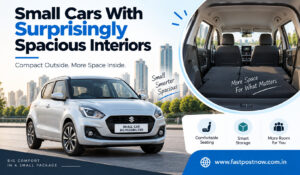
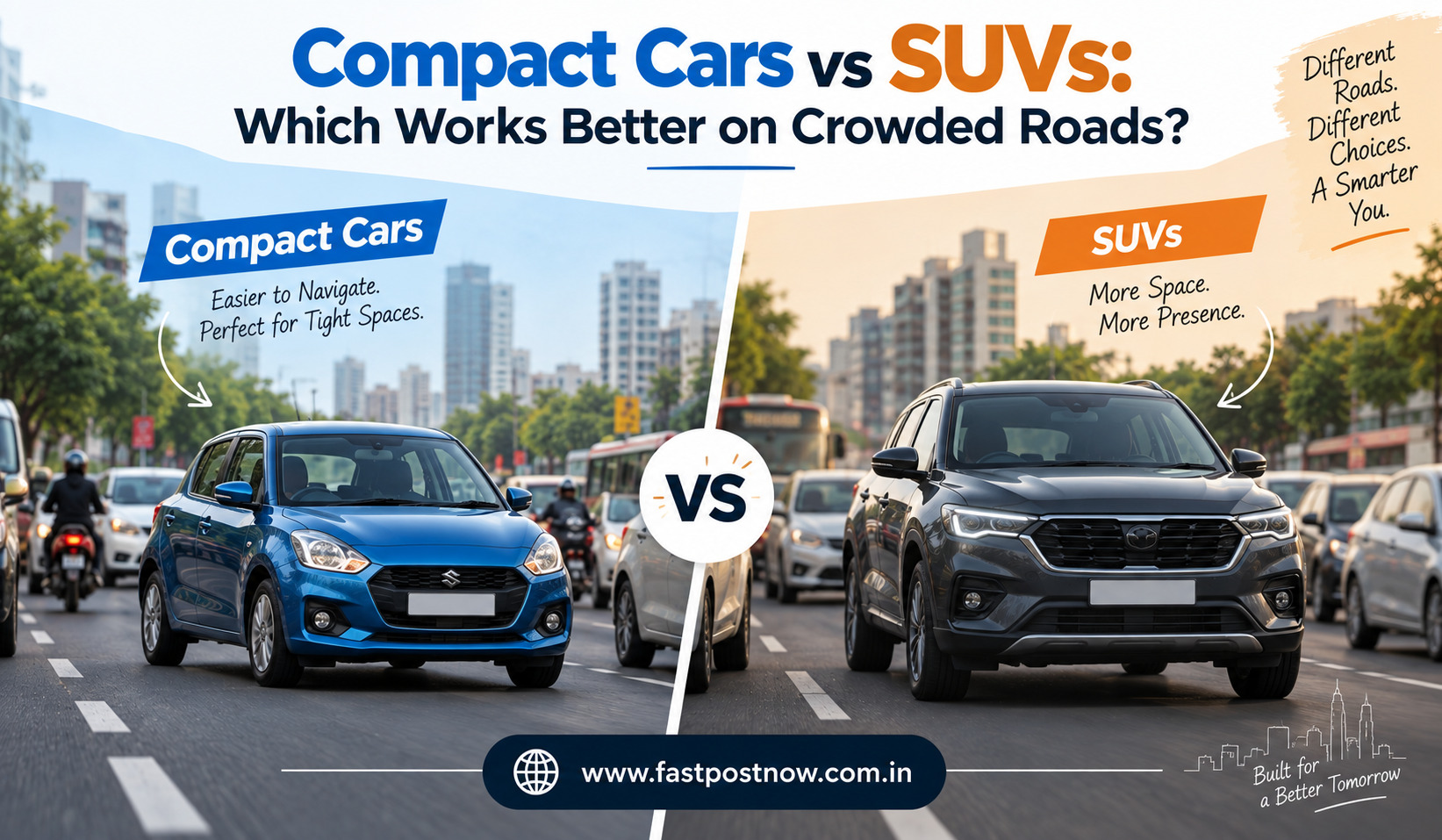
Driving in a crowded city can be challenging even when you are an experienced driver. Narrow lanes, heavy traffic, motorcycles, pedestrians, tight parking spaces and unpredictable road movements can make everyday commuting stressful. This is why choosing the right type of car matters, particularly for people who spend most of their time driving in busy urban areas.
One of the biggest questions for city-car buyers is whether a compact car or SUV is the better choice for crowded roads.
Compact cars generally offer smaller dimensions, easier manoeuvrability and simpler parking. SUVs, particularly compact SUVs, provide a higher seating position, more cabin space and greater road presence. Neither body style is automatically better for every driver.
The right choice depends on your priorities, driving environment and how frequently you deal with congested roads.
What Makes a Car Suitable for Crowded Roads?
A good city car needs to be easy to position, turn and park. Exterior dimensions are therefore important.
A shorter and narrower vehicle can make it easier to navigate tight streets and squeeze into smaller parking spaces. A smaller turning circle can also reduce the number of manoeuvres required in confined areas.
Visibility is another consideration. A higher seating position can give some SUV drivers a better view over nearby traffic, but vehicle width and length can make an SUV more difficult to place in very narrow spaces.
Safety technology also matters. Features such as parking sensors, a reversing camera, electronic stability control and airbags can make either type of vehicle more practical for urban driving.
Compact Cars Have an Advantage in Tight Spaces
Compact cars are designed with urban practicality in mind.
Take the Maruti Suzuki Swift, for example. The current India-market Swift measures 3,860 mm in length and 1,735 mm in width, with a 2,450 mm wheelbase. Maruti Suzuki also lists a 4.8-metre turning radius.
Those dimensions make the Swift relatively easy to position on narrow roads and in crowded parking areas.
For drivers who regularly encounter small lanes, busy market areas or older residential neighbourhoods with limited road space, a compact hatchback can feel less intimidating.
Its smaller footprint can also make parallel parking and reversing into tight spaces easier.
Compact Cars Can Be Easier to Park
Parking is one of the strongest arguments in favour of compact cars.
A smaller vehicle usually requires less space, which can be valuable in cities where parking spots are limited. The driver also has less bodywork to judge when moving close to walls, pillars or other vehicles.
The Swift currently offers reverse parking sensors and a reverse camera on applicable variants, while Maruti Suzuki also lists features such as ABS with EBD, Electronic Stability Program, hill-hold assist and six airbags.
These features can make an already manoeuvrable car easier and safer to use in busy urban environments.
But Compact Cars Are Not Always the Clear Winner
A smaller exterior does not automatically mean a better overall city experience.
Some buyers may find the lower seating position of a hatchback less appealing when surrounded by taller vehicles. Getting in and out can also be less convenient for certain passengers.
If you frequently carry several people, shopping bags, luggage or child seats, the additional cabin height and space offered by some SUVs may become more valuable.
This is where compact SUVs enter the discussion.
Compact SUVs Offer a Middle Ground
A compact SUV can provide some of the advantages associated with SUVs without becoming as large as a full-size vehicle.
The Hyundai EXTER is a current example. Hyundai’s India website lists the new EXTER at 3,830 mm long, 1,723 mm wide and 1,643 mm high, with a 2,450 mm wheelbase. Its petrol versions offer 391 litres of boot space.
Interestingly, its length and width are very close to those of the Swift. This demonstrates why buyers should not assume that every SUV will be dramatically larger than every hatchback.
The EXTER’s taller body provides a more upright driving position while keeping its overall footprint relatively manageable.
SUVs Can Provide Better Visibility
One reason many city drivers prefer SUVs is their seating position.
Sitting higher can provide a different perspective over nearby traffic and may make it easier to see vehicles farther ahead in some situations.
The higher stance can also make entering and exiting the vehicle more convenient for many passengers.
However, a higher driving position should not be confused with complete visibility. Large pillars, parked vehicles, motorcycles and other road users can still create blind spots.
Good mirror adjustment, careful observation and parking assistance remain essential.
SUVs Can Be More Comfortable for Family Use
If your car frequently carries four or five passengers, an SUV can offer a more appealing combination of cabin space and practicality.
The Hyundai CRETA, for example, is considerably larger than the Swift and EXTER. Hyundai’s current India specifications list the CRETA at 4,330 mm long, 1,790 mm wide and 1,635 mm high, with a 2,610 mm wheelbase.
That larger footprint contributes to its more spacious SUV character, but it also means drivers need to account for more vehicle length and width when navigating narrow roads or parking spaces.
For families, the additional space can be worthwhile. For someone who mostly drives alone through congested streets, it may not be necessary.
What About Traffic Jams?
In stop-and-go traffic, neither body style automatically has an advantage.
Transmission choice can sometimes matter more than body type.
An automatic or automated manual transmission can reduce the need for repeated clutch operation in heavy traffic. However, buyers should evaluate how the specific transmission behaves during crawling traffic and parking manoeuvres.
The current Swift is available with both manual and AGS automatic options, according to Maruti Suzuki.
For a city commuter, choosing a transmission that feels comfortable during long traffic jams may have a bigger impact on daily satisfaction than choosing between a hatchback and SUV purely on appearance.
Turning Radius Matters More Than Many Buyers Realise
When comparing vehicles for crowded roads, don’t focus only on length and width.
Turning radius affects how easily a vehicle can make a U-turn, enter a narrow street or manoeuvre around obstacles.
A smaller turning requirement can reduce the number of steering adjustments needed in confined areas.
This is one reason compact hatchbacks often feel particularly convenient in dense urban neighbourhoods.
However, wheelbase, steering calibration, visibility and the driver’s familiarity with the vehicle also influence how easy a car feels to manoeuvre.
Parking Technology Can Change the Experience
Modern parking assistance can reduce some of the disadvantages of driving a larger vehicle in a crowded city.
Rear parking sensors can warn the driver about obstacles behind the car, while a reversing camera provides a visual reference.
More advanced vehicles may offer a 360-degree camera or other parking assistance technology.
The current Hyundai CRETA offers advanced visibility equipment including a Surround View Monitor on applicable configurations, while the EXTER includes rear parking sensors and offers a rear camera depending on variant.
These features can be particularly useful in apartment parking lots, shopping-centre garages and narrow urban spaces.
Safety Should Not Be Sacrificed for Size
Some buyers assume that a larger SUV is automatically safer than a compact car.
That is too simplistic.
Vehicle safety depends on structural design, restraint systems, airbags, electronic stability systems, braking technology and other factors. Buyers should compare the actual safety equipment and independent crash-test information available for the specific vehicle.
For example, the current Swift lists six airbags, ABS with EBD, Electronic Stability Program, hill-hold assist and ISOFIX.
The current EXTER also lists a broad range of safety equipment, including six airbags and electronic stability-related technologies.
The lesson is simple: don’t choose a vehicle based solely on its body style.
Compact Car vs SUV: Which Is Better for City Driving?
A compact car is generally the better choice if your priorities include easy parking, narrow-road manoeuvrability, a smaller footprint and straightforward urban driving.
An SUV can make more sense if you value a higher seating position, greater cabin space, easier entry and exit, and additional practicality for family use.
A compact SUV can be an attractive compromise because it combines some SUV characteristics with dimensions that remain manageable in urban environments.
Your daily route should ultimately determine the decision.
If you frequently drive through extremely narrow lanes and crowded markets, a smaller hatchback may make life easier. If your commute combines city traffic with highways and you regularly carry passengers, a compact SUV may provide a better balance.
Things to Check During a Test Drive
Don’t make the decision based only on brochures.
During a test drive, try the vehicle on roads similar to your regular route. Test how easily you can judge its corners, how much visibility you have around the bonnet, how comfortable it feels in slow traffic and how easily you can park.
Also check whether the driver’s seat provides enough adjustment, whether the mirrors cover useful areas and whether parking sensors or cameras are easy to interpret.
If possible, have your regular passengers sit inside the vehicle. A car that feels perfect from the driver’s seat may not offer the space your family needs.
Final Verdict
So, compact cars vs SUVs: which works better on crowded roads?
For pure manoeuvrability and parking convenience, a compact hatchback generally has the advantage. A model such as the current Maruti Suzuki Swift offers a relatively small footprint and city-friendly dimensions.
A compact SUV such as the Hyundai EXTER can offer a useful middle ground, combining manageable dimensions with a taller SUV-style body and practical space.
A larger compact SUV such as the Hyundai CRETA provides more room but demands greater awareness of its dimensions in tight spaces.
Ultimately, the best car for crowded roads is not necessarily the smallest or largest one. It is the vehicle whose dimensions, visibility, safety equipment, parking technology and practicality match your everyday driving conditions.
Before buying, compare the exact variants, sit in both types of vehicles and take them through the kind of roads you use regularly. That real-world experience can tell you far more than the body style printed on a brochure.