
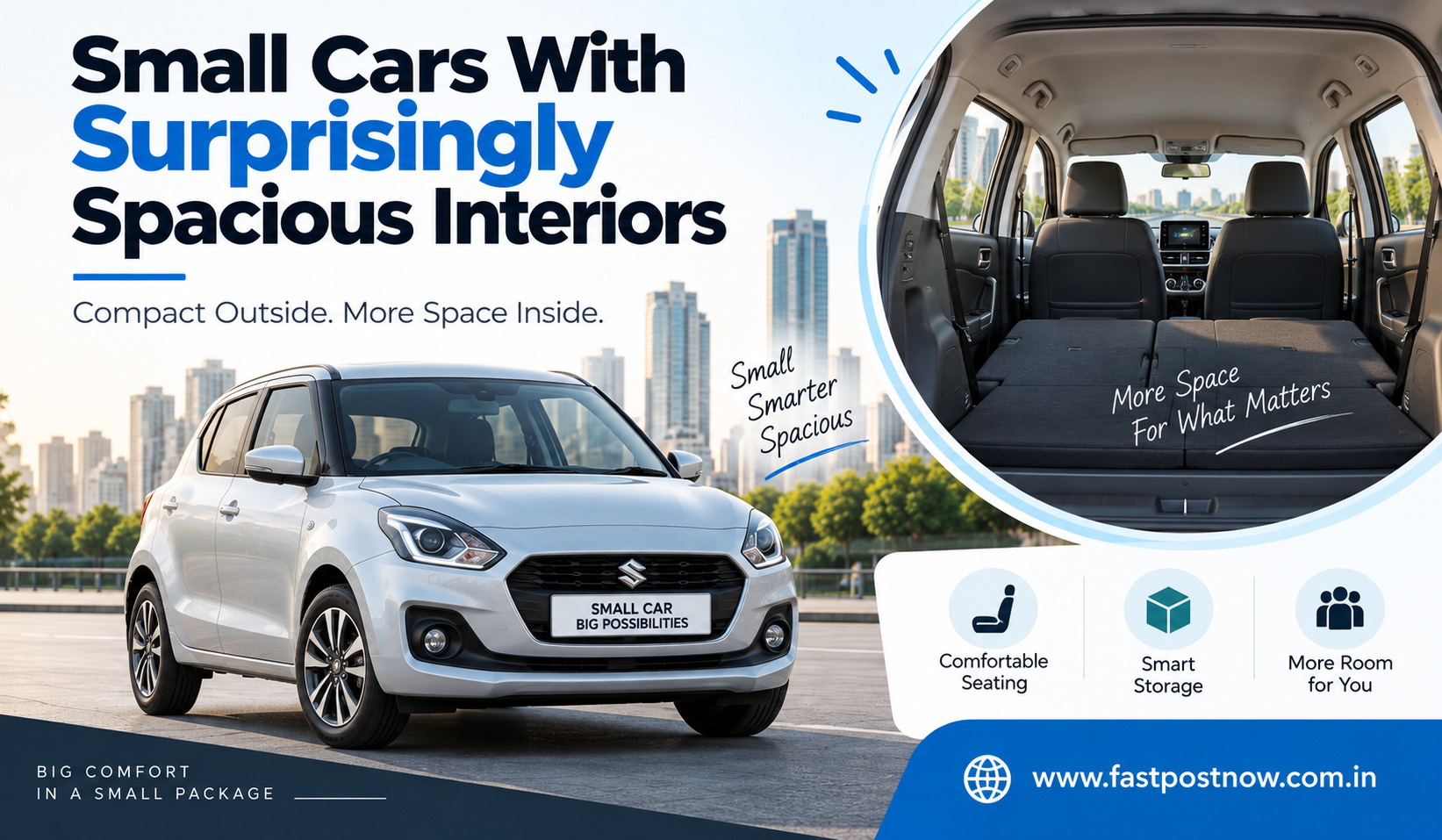
A small car does not necessarily mean a cramped cabin. In fact, some of the most practical cars for Indian cities are compact models that use clever interior design to create more usable space than their exterior dimensions suggest.
For first-time buyers, small cars can be appealing because they are easier to manoeuvre through crowded streets, simpler to park and often easier to manage in everyday traffic. But buyers also want enough room for passengers, luggage and daily essentials.
The good news is that modern hatchbacks increasingly focus on making every centimetre of cabin space useful. Tall rooflines, carefully positioned seats, wide-opening doors and smart storage areas can make a relatively small vehicle feel surprisingly comfortable inside.
Here are some small cars with spacious interiors that deserve attention in the Indian market.
What Makes a Small Car Feel Spacious?
Interior space is not determined by exterior length alone.
A car can have a relatively short body but still provide generous headroom and useful legroom if its cabin has been designed efficiently. A tall roof can make the interior feel more open, while a well-designed dashboard can create additional perceived space for the occupants.
Seat positioning also matters. The distance between the front and rear seats, the shape of the front seatbacks and the position of the floor can all affect how comfortable rear passengers feel.
Large windows can make a cabin feel airier, while thoughtful storage compartments can prevent the interior from becoming cluttered.
This is why buyers should sit inside a car rather than judging cabin space purely from its exterior appearance.
1. Maruti Suzuki WagonR: The Tall-Boy Space Specialist
The Maruti Suzuki WagonR has long been associated with practical interior packaging.
Its tall-boy design gives the cabin a noticeably upright character. The current WagonR measures 3,655 mm in length, 1,620 mm in width and 1,675 mm in height, with a wheelbase of 2,435 mm. Maruti Suzuki’s current brochure also lists 335 litres of boot space for the petrol version.
Those dimensions help explain why the WagonR can feel roomier inside than its compact footprint suggests.
The tall body provides useful headroom, while the upright seating position makes getting into and out of the car relatively straightforward.
For families who frequently use a car for city commuting, school runs or shopping trips, this type of packaging can be more valuable than simply having a longer bonnet or larger exterior.
The current WagonR is also available with petrol and S-CNG powertrains, along with manual and AGS transmission options depending on the variant.
Why the WagonR Feels Bigger Inside
The WagonR’s biggest strength is not simply its dimensions but how those dimensions are used.
Its tall roof allows passengers to sit relatively upright, creating a sense of openness. The large glass area also contributes to a more spacious visual impression.
For rear passengers, the upright design can make the cabin feel less restrictive than some low-slung hatchbacks.
Its 335-litre petrol boot is another practical advantage for buyers who regularly carry groceries, backpacks or small pieces of luggage.
This makes the WagonR particularly interesting for buyers who want maximum practicality without moving into a larger vehicle.
2. Hyundai Grand i10 NIOS: Compact Outside, Roomy Inside
The Hyundai Grand i10 NIOS is another small hatchback that focuses strongly on cabin usability.
Hyundai’s current India website lists the car at 3,815 mm long, 1,680 mm wide and 1,520 mm high, with a 2,450 mm wheelbase.
Its exterior footprint remains relatively compact, making it suitable for urban environments, while Hyundai describes the cabin as offering spacious internal dimensions.
The interior has been designed around everyday passenger comfort rather than simply minimising the size of the vehicle.
The Grand i10 NIOS can accommodate five occupants and is available with petrol and Hy-CNG Duo configurations. Hyundai’s current lineup includes several variants, including Era, Magna, Corporate, Sportz, Sportz VIBE, Sportz (O), Sportz (O) VIBE and Asta.
A Practical Cabin for Everyday Families
One reason the Grand i10 NIOS can appeal to families is its balance between exterior size and interior usability.
The relatively wide body compared with some entry-level hatchbacks can help the cabin feel less narrow. Hyundai also offers features such as rear AC vents on applicable configurations, which can make the rear compartment more comfortable during hot-weather driving.
The current Grand i10 NIOS also offers adjustable rear headrests and multiple storage areas, depending on the variant.
Another interesting development is the Hy-CNG Duo configuration. Hyundai says its dual-cylinder setup is designed to provide more boot space compared with a conventional large single-cylinder arrangement.
That can make the CNG version particularly interesting for buyers who want lower running costs without giving up everyday practicality.
3. Renault Kwid: Small Footprint With Useful Space
The Renault Kwid takes a different approach to making a small car practical.
Renault’s current India website lists the Kwid at 3,731 mm long, 1,579 mm wide and 1,474 mm high, with a 2,422 mm wheelbase. It also lists 279 litres of boot space.
The compact dimensions make the Kwid particularly suitable for narrow city roads and tight parking areas.
Its cabin is not designed to compete with a larger hatchback for outright passenger room, but its packaging makes good use of its small footprint.
The current Kwid also offers a 20.32 cm touchscreen MediaNAV system, depending on version, along with features such as rear parking sensors and a rear camera on the Climber variant.
For buyers prioritising easy urban manoeuvrability while still wanting useful boot space, the Kwid remains an interesting option.
Why Boot Space Matters in a Small Car
Interior room is not only about passenger seating.
A car can feel spacious inside but still become inconvenient if its luggage compartment is too small for everyday needs.
This is where models such as the WagonR stand out. Its manufacturer-listed 335-litre petrol boot provides useful carrying capacity for a car of its size.
The Grand i10 NIOS also focuses on practical packaging, while Hyundai’s current Hy-CNG Duo configuration is specifically designed to improve usable boot space compared with a conventional CNG arrangement.
When comparing small cars, consider what you actually carry. A large weekly grocery load, stroller or multiple suitcases may make boot design more important than a few extra millimetres of rear legroom.
Small Cars Can Be Better for City Living
A compact exterior can be a major advantage in India’s crowded cities.
Narrow lanes, roadside parking and congested markets are easier to navigate when the car does not occupy excessive road space.
The Renault Kwid, for example, has a width of just 1,579 mm, while the WagonR is 1,620 mm wide and the Grand i10 NIOS is 1,680 mm wide.
These differences may seem small on paper, but they can become noticeable when navigating tight spaces or parking alongside other vehicles.
A compact car can also reduce the stress of finding parking in crowded neighbourhoods.
Spacious Does Not Always Mean Luxurious
There is an important difference between spaciousness and premium feel.
A small car can offer excellent passenger space without having the soft materials, large screens or premium finishes associated with more expensive vehicles.
For buyers focused on practicality, this is not necessarily a disadvantage.
A well-designed small cabin with comfortable seats, sufficient headroom and usable storage can be more valuable than a visually impressive interior that sacrifices passenger space.
Therefore, when evaluating a car, consider how comfortably people can actually sit rather than judging the cabin by its dashboard design alone.
What to Check During a Test Drive
If interior space is a major buying priority, a showroom visit is essential.
Start by sitting in the driver’s seat and adjusting it to your preferred position. Then sit in the rear seat behind the driver’s position.
Check whether your knees have enough room and whether your head touches the roof.
Try getting into and out of the rear seat. Pay attention to the door opening, seat height and floor arrangement.
If you regularly carry family members, take them with you for the test drive. A car that appears spacious to one person may feel different to another.
Also inspect the boot with the rear seats in their normal position. Think about whether it can accommodate your usual shopping bags, luggage or other items.
Small Car, Big Practicality
The biggest advantage of these cars is that they demonstrate how clever engineering can make a small footprint surprisingly useful.
The WagonR focuses on vertical space and practical packaging. The Grand i10 NIOS combines a compact exterior with a cabin Hyundai describes as spacious and offers several comfort-focused features. The Kwid prioritises compact dimensions while providing a useful 279-litre boot.
None of these approaches is automatically better. The right choice depends on how many people you carry, how much luggage you need and where you normally drive.
Final Thoughts
Small cars with spacious interiors can offer an excellent combination of urban manoeuvrability and everyday practicality.
The Maruti Suzuki WagonR is particularly appealing if maximum cabin height and useful boot space are priorities. The Hyundai Grand i10 NIOS offers a balanced package with a compact footprint and a cabin designed around passenger comfort. The Renault Kwid is worth considering for buyers who want very compact exterior dimensions without giving up a practical boot.
The important lesson is that exterior size does not tell the whole story.
Before buying, compare actual dimensions, sit in the front and rear seats, inspect the boot and take a proper test drive. A well-packaged small car can provide enough room for daily family use while remaining easy to drive and park in India’s busiest cities.