
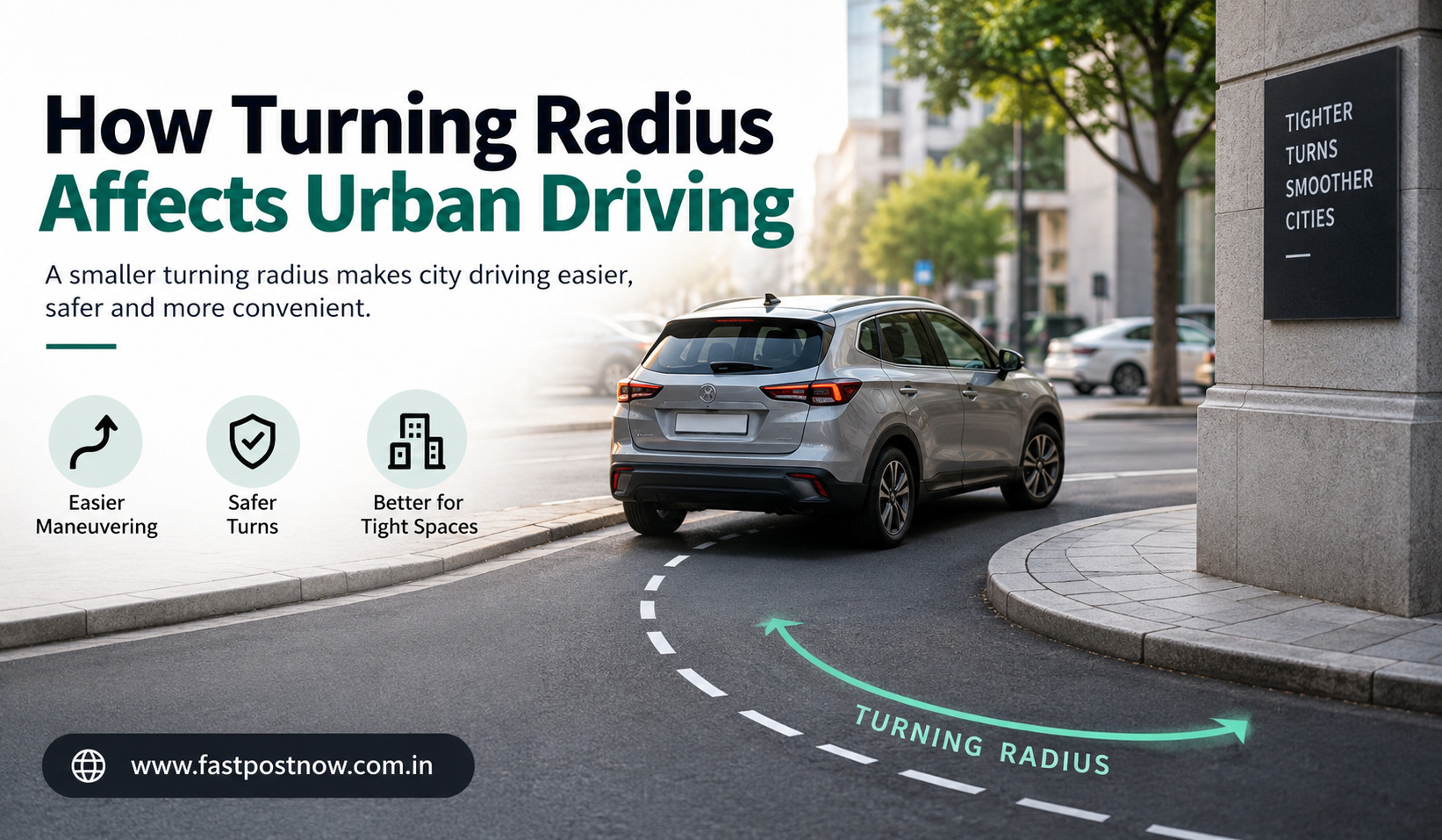
Driving in a busy city is very different from travelling on an open highway. Urban roads often involve narrow lanes, crowded intersections, tight parking areas, U-turns, flyovers, apartment garages and vehicles moving in every direction. In these conditions, even small differences in a car’s manoeuvrability can affect how easy it feels to drive.
One specification that deserves more attention from city-car buyers is the turning radius.
You may have seen the term in a car’s specification sheet without giving it much thought. However, turning radius can influence how easily a vehicle makes a U-turn, navigates a narrow street or gets into a tight parking space.
Understanding how it works can help you choose a car that suits your daily driving environment.
What Is Turning Radius?
Turning radius describes the smallest circular path a vehicle can make when its steering is turned as far as the vehicle allows.
In simple terms, it indicates how tightly a car can turn.
A car with a smaller turning radius generally needs less space to complete a tight turn. A vehicle with a larger turning radius may require more room and potentially more steering manoeuvres.
Manufacturers often quote the minimum turning radius in metres. It is important to understand that the published figure is a technical measurement and real-world manoeuvrability can also depend on factors such as steering response, vehicle dimensions, wheelbase, tyres and the driver’s experience.
Why Turning Radius Matters in Cities
Urban roads regularly put a vehicle into situations where tight manoeuvring is necessary.
You may need to make a U-turn on a relatively narrow road, turn into a small residential lane or manoeuvre around parked vehicles.
A car that can turn in a tighter space can make these situations easier.
This does not mean turning radius is the only factor that matters. Visibility, vehicle width, length, steering feel and parking assistance also influence how comfortable a car feels in the city.
Nevertheless, turning radius is a useful specification to consider alongside those factors.
Smaller Turning Radius Can Make U-Turns Easier
One of the clearest benefits of a tight turning radius is easier U-turning.
Imagine a road where there is limited space between the kerb and the opposite side of the road. A vehicle capable of making a tighter turn may complete the manoeuvre in fewer movements.
This can be particularly helpful on urban roads where traffic is moving around you.
A smaller turning radius can also reduce the need to reverse and reposition the vehicle during a tight U-turn.
For inexperienced drivers, that can make city driving less stressful.
Parking Can Become More Convenient
Parking is another situation where turning ability matters.
When entering a compact parking space, drivers often need to make several steering corrections. A vehicle that can manoeuvre within a smaller area can make the process easier.
This becomes particularly noticeable in older apartment buildings, underground parking garages and crowded commercial areas where spaces can be narrow.
However, turning radius should not be considered in isolation.
A car may have a good turning radius but still require careful manoeuvring because of its overall width, length or visibility.
This is why a test drive is valuable.
Turning Radius and Narrow Indian Streets
Many Indian cities contain roads that were not designed around modern traffic volumes.
Residential streets can become narrower because of parked vehicles, roadside shops, pedestrians and two-wheelers.
In such situations, a compact vehicle with good low-speed manoeuvrability can be easier to manage.
A smaller turning radius can help the driver make sharper turns without repeatedly moving forward and backward.
This is one reason compact hatchbacks continue to appeal to urban drivers even as SUVs become increasingly popular.
Maruti Suzuki Swift as a City-Car Example
The Maruti Suzuki Swift is a useful current example when discussing turning radius.
Maruti Suzuki’s current India specification page lists the Swift with a minimum turning radius of 4.8 metres. The same manufacturer page lists a length of 3,860 mm, width of 1,735 mm and wheelbase of 2,450 mm.
These figures help explain why the Swift is well suited to everyday urban manoeuvring.
Its relatively compact dimensions combined with the manufacturer’s 4.8-metre turning-radius figure can make it easier to position in tight city environments.
The Swift is also currently available in India, including petrol and petrol-CNG configurations, so it is not an outdated or discontinued example.
Does a Larger Car Always Have a Larger Turning Radius?
Not necessarily.
Vehicle size is related to manoeuvrability, but it does not determine turning radius by itself.
Wheelbase, steering geometry, front-wheel movement and other engineering factors influence how tightly a vehicle can turn.
This is why buyers should not simply assume that every small car has a dramatically better turning radius than every SUV.
Two vehicles of similar exterior length can have different manoeuvring characteristics.
The best approach is to compare the manufacturer’s published figures where they are available and then test-drive the vehicles in realistic conditions.
Wheelbase Also Plays a Role
Wheelbase is the distance between the front and rear axles.
It can influence a vehicle’s manoeuvrability, although it is not the only factor determining turning radius.
A longer-wheelbase vehicle can require more space for certain manoeuvres, while a shorter-wheelbase vehicle may feel easier to turn around in confined areas.
However, steering geometry can offset some of these differences.
This is why simply comparing wheelbase numbers is not enough to predict exactly how a car will feel during a U-turn.
Turning radius and wheelbase should be considered together with the car’s width, length and steering characteristics.
Turning Radius vs Turning Circle
These terms are sometimes used interchangeably, but buyers should pay attention to how the manufacturer defines its measurement.
A turning radius describes the radius of the circular path, while a turning circle can refer to the overall diameter of that path.
This distinction matters because a larger numerical value does not necessarily mean the same thing if two manufacturers use different measurement conventions.
For reliable comparisons, use figures published under the same terminology and from the manufacturers themselves whenever possible.
What About SUVs?
SUVs are not automatically difficult to manoeuvre.
Modern compact SUVs can be surprisingly easy to use in cities because manufacturers increasingly design them for urban environments.
The Hyundai EXTER, for example, is currently sold in India and measures 3,830 mm in length and 1,723 mm in width, according to Hyundai India’s current specifications.
Hyundai describes the current EXTER as a compact SUV designed for city driving as well as longer journeys. Its compact overall dimensions can help make it manageable in urban environments, although buyers should not assume a particular turning-radius figure without checking the manufacturer’s latest specification.
The important point is that body style alone does not determine manoeuvrability.
Parking Sensors and Cameras Can Reduce the Stress
Turning radius helps with physical manoeuvrability, but modern parking technology can make a significant difference as well.
Rear parking sensors can warn drivers about nearby obstacles, while reversing cameras provide a visual view of the area behind the vehicle.
These technologies are especially useful when the car is already in a tight space.
For example, the current Hyundai EXTER offers rear parking assistance features, with equipment varying according to variant. Hyundai’s official feature list shows that its safety and convenience equipment differs across trims.
A good turning radius combined with effective parking assistance can make a car considerably easier to manage in crowded urban environments.
Why Test Drives Matter
Specification sheets can tell you a lot, but they cannot completely predict how a car will feel.
During a test drive, find a safe location where you can make a tight turn.
Pay attention to how quickly the vehicle responds to steering input, how much space you need to complete the turn and how easily you can judge the front and rear corners.
Try parking as well.
A car that looks ideal on paper may feel less convenient if you struggle to judge its edges. Another vehicle with similar dimensions may feel easier because of better visibility and steering response.
Your own comfort behind the wheel is therefore an important part of the decision.
Turning Radius Is Especially Important for First-Time Buyers
New drivers can benefit significantly from a vehicle that feels predictable at low speeds.
Tight residential roads and crowded parking areas can be intimidating when you are still developing confidence.
A car with manageable dimensions and a good turning radius can reduce the number of corrections needed during tight manoeuvres.
However, first-time buyers should not choose a vehicle based on turning radius alone.
Safety equipment, braking performance, visibility, seat comfort and ease of operation are equally important.
Other Factors That Affect Urban Manoeuvrability
When comparing cars, look beyond turning radius and consider:
Vehicle width: A narrower car can be easier to position on tight roads.
Vehicle length: A shorter body can make parking and tight turns easier.
Visibility: Good visibility can help you judge obstacles and road edges.
Steering response: Predictable steering can make low-speed manoeuvring more comfortable.
Parking sensors: These can provide additional awareness around the vehicle.
Reversing camera: A camera can make tight parking easier.
Driver position: A comfortable seating position can improve your ability to judge the car’s dimensions.
Together, these characteristics determine how easy a vehicle feels to operate in real city conditions.
Is a Smaller Turning Radius Always Better?
Not necessarily.
A smaller turning radius is generally useful for tight manoeuvres, but it should not be treated as the single most important specification.
A vehicle with a slightly larger turning radius may still be easier to drive if it has excellent visibility, accurate steering, compact width and effective parking assistance.
Similarly, a car with a very tight turning radius may not suit you if the seating position, dimensions or driving characteristics do not feel comfortable.
Think of turning radius as one part of the overall urban-driving equation.
Final Thoughts
Turning radius can have a noticeable impact on urban driving, particularly when making U-turns, navigating narrow streets and parking in confined spaces.
A smaller minimum turning radius generally means the vehicle can complete a tight turn using less space. The current Maruti Suzuki Swift, for example, has an officially listed 4.8-metre minimum turning radius, making it a useful example of a compact city car with a clearly published manoeuvrability figure.
But turning radius is only one factor.
Vehicle width, length, wheelbase, steering behaviour, visibility, parking sensors and cameras can all affect how easy a car is to drive in crowded urban conditions.
When choosing your next city car, check the manufacturer’s specifications, but also take the vehicle through the kinds of roads and parking areas you use every day.
The best urban car is not simply the one with the smallest turning radius. It is the one that gives you confidence, control and predictable manoeuvrability when space is limited.