
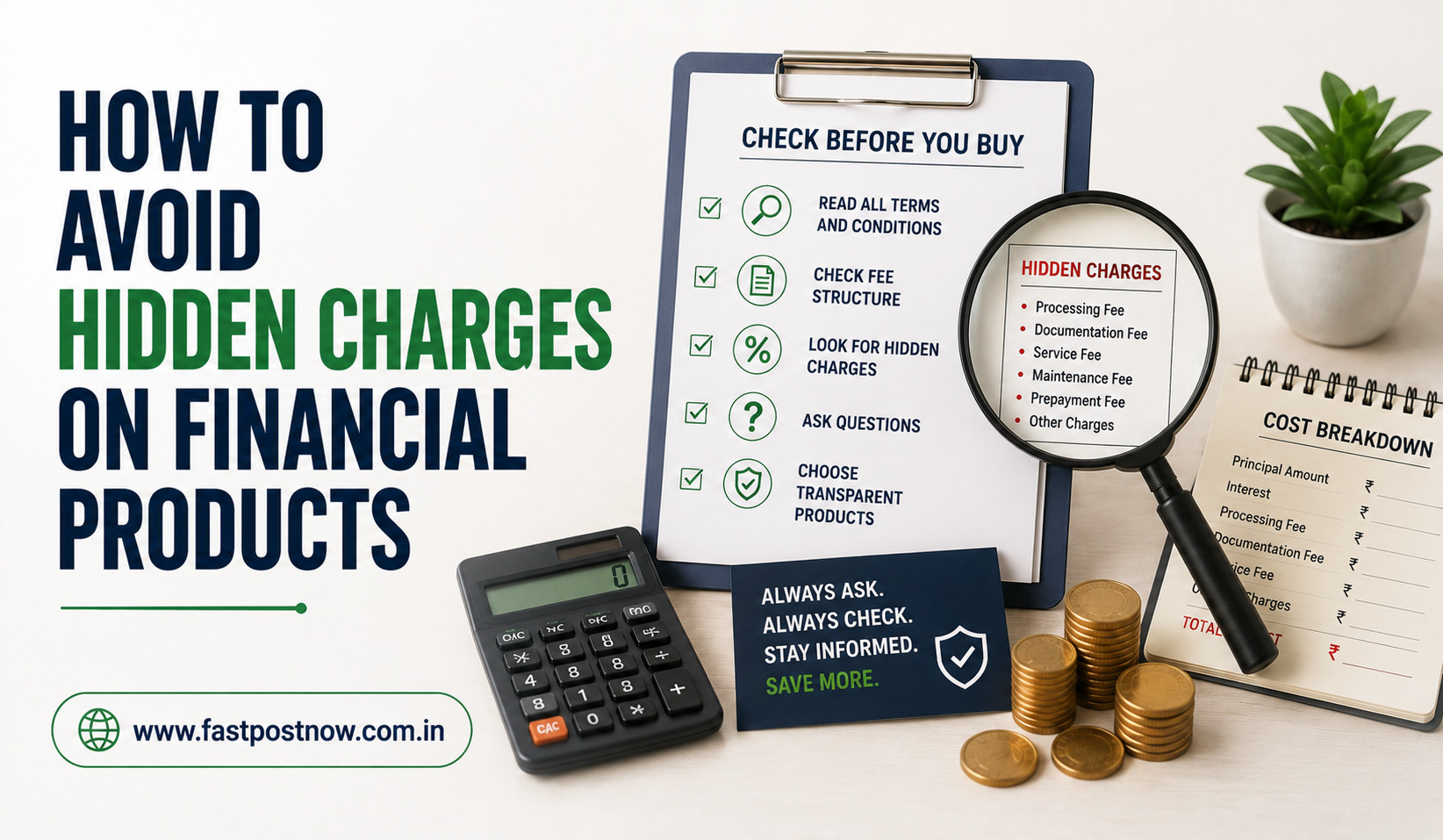
Financial products can make everyday money management easier, whether you are opening a bank account, taking a loan, using a credit card, buying insurance, investing, or choosing a savings product. However, the advertised interest rate, reward, return, or monthly payment does not always tell you the full cost.
Additional charges can appear in the form of processing fees, service fees, penalties, transaction charges, renewal costs, taxes, or conditions attached to certain features. Some of these costs are clearly disclosed, while others may be buried in lengthy terms and conditions or become applicable only when you use a particular service.
Learning how to identify these charges before signing up can help you make better financial decisions. The goal is not to avoid every fee—some charges may be reasonable and unavoidable—but to understand exactly what you are paying for and whether the product remains worthwhile after all costs are included.
What Are Hidden Charges in Financial Products?
Hidden charges are costs that a customer may not immediately notice when evaluating a financial product. The term does not necessarily mean that a financial institution is deliberately concealing a fee. In many cases, the charge may be mentioned somewhere in the product documentation but overlooked by the customer.
For example, a loan advertisement might highlight an attractive interest rate while the actual borrowing cost also includes processing fees, documentation charges, insurance-related costs, or other applicable expenses.
Similarly, a bank account may appear free but impose charges when the balance falls below a required level, when certain transactions exceed a monthly limit, or when specific services are requested.
The important distinction is between the headline price and the total cost.
Why Do Financial Products Have Additional Charges?
Financial institutions provide different services, and many involve administrative, operational, transaction, or risk-related costs. Fees may therefore be attached to specific services or activities.
For customers, the challenge is understanding which charges apply to normal use and which are triggered only in particular situations.
For instance, a loan may have a processing fee when it is initially approved, while a credit card may have a fee for late payments. An investment product may have transaction-related costs, while an insurance policy may have charges associated with certain changes or cancellations.
A product with several fees is not necessarily a bad product. What matters is whether the total cost is reasonable compared with the benefits you receive.
Common Types of Charges to Watch For
Different financial products use different fee structures. Some charges are easy to identify, while others require closer examination.
| Financial Product | Charges You May Need to Check |
| Bank account | Minimum-balance, transaction, ATM, service, and statement charges |
| Loan | Processing, documentation, late-payment, prepayment, and other applicable fees |
| Credit card | Annual, late-payment, cash-advance, foreign-transaction, and interest charges |
| Insurance | Premium-related, policy-change, cancellation, or other applicable charges |
| Investment product | Transaction, management, exit, or platform-related costs |
| Fixed or recurring deposit | Premature withdrawal conditions and applicable penalties |
The exact charges vary between institutions and products. Always read the current fee schedule applicable to the specific product you are considering.
Read the Fee Schedule Before Signing Up
One of the simplest ways to avoid unexpected charges is to find the official fee schedule before opening an account or accepting a financial product.
Marketing pages are designed to communicate the main benefits quickly. They may not display every possible cost in the same prominent position.
The fee schedule, product disclosure document, terms and conditions, or equivalent documentation is more useful when you want to understand the complete pricing structure.
Do not stop after checking the first few charges. Look for sections covering transactions, penalties, account maintenance, changes, cancellations, withdrawals, and other special situations.
If a fee is unclear, ask the provider to explain when it applies and how much you could be charged.
Understand the Difference Between Interest and Fees
When comparing financial products, people often focus heavily on the interest rate. However, interest is only one component of the total cost.
Consider two loans that appear similar. One has a slightly lower interest rate but substantial processing and administrative charges. The other has a slightly higher rate but much lower fees.
Depending on the loan amount and repayment period, the second option could potentially cost less overall.
The same principle applies to other products. A credit card with attractive rewards may have an annual fee. An investment product with appealing returns may have several associated costs. A bank account offering additional services may charge for transactions beyond certain limits.
Always evaluate the product as a complete package.
Ask for the Total Cost in Writing
If you are considering a major financial product, do not rely entirely on verbal explanations.
Ask the institution to provide the applicable charges and important terms in writing. This gives you something concrete to review before making a commitment.
For loans, ask for a clear breakdown of the amount being borrowed, interest rate, fees, repayment schedule, and total expected repayment. For insurance, understand the premium, coverage, exclusions, and applicable policy-related charges. For investment products, identify the costs associated with buying, holding, selling, or exiting the investment.
A written breakdown also makes it easier to compare competing products.
Look Beyond “Zero Fee” and “No Cost” Claims
Promotional phrases such as “zero fee,” “no annual charge,” or “low-cost” can be attractive, but they need context.
A product may waive one particular fee while charging for another service. A promotional waiver may also apply only for a limited period or only when certain conditions are met.
For example, a financial product might have no initial fee but introduce a recurring charge after the promotional period ends.
Whenever you see a “free” or “zero-cost” claim, ask:
- What exactly is free?
- How long does the waiver last?
- Are there conditions attached?
- Which other charges still apply?
This simple habit can prevent many unpleasant surprises.
Check Conditions Attached to Fee Waivers
Fee waivers are often conditional. A bank may waive a maintenance fee if you maintain a certain balance. A card issuer may waive an annual fee if you spend a specified amount. Another product may offer a reduced fee only when you meet certain eligibility conditions.
These arrangements can be useful, but only if the conditions naturally fit your financial behavior.
Do not spend unnecessarily just to qualify for a fee waiver. Similarly, do not keep more money in an account than you need solely to avoid a small maintenance fee if doing so creates a larger opportunity cost.
The right question is whether the condition makes financial sense for you.
Understand Penalties Before Using a Product
Some of the most expensive charges arise not during normal usage but when something goes wrong.
Late-payment fees, failed-payment charges, premature withdrawal penalties, prepayment charges, and other penalties can increase the cost of a financial product.
Before signing an agreement, understand what happens if you miss a payment, withdraw money early, close an account, exceed a limit, or change the original arrangement.
This is particularly important for loans and credit products because penalties can be combined with additional interest or other costs.
Check Automatic Renewals
Automatic renewal can sometimes result in unexpected charges.
Subscriptions and financial services may renew automatically unless you cancel them before a specified date. Certain insurance or service arrangements may also continue according to their renewal terms.
Before accepting automatic renewal, understand the renewal date, revised pricing, cancellation process, and notice period.
It is also useful to review recurring financial payments periodically. A service that was useful several years ago may no longer be necessary.
Pay Attention to Transaction Limits
Some financial products include a certain number of free transactions and then charge a fee after the limit is exceeded.
This can happen with bank accounts, cards, investment platforms, and other financial services.
If you frequently use a particular service, estimate your normal transaction volume before choosing the product. A fee structure that works for an occasional user may become expensive for someone who makes frequent transactions.
For example, a bank account with several free transactions might be suitable for one customer but expensive for another who regularly exceeds the permitted limit.
Understand Foreign and Currency-Related Charges
People who make international transactions should pay particular attention to currency conversion and foreign-transaction costs.
The amount you see on a foreign transaction may not represent the complete cost. Currency conversion rates, transaction fees, and other applicable charges can affect the final amount.
Before using a financial product internationally, check how exchange rates are determined and whether additional charges apply.
This is especially important for frequent travelers, international shoppers, and people who regularly send or receive money across borders.
Compare Products Using Total Cost
The easiest way to avoid misleading comparisons is to create a simple cost comparison.
Suppose you are comparing two financial products:
| Cost Factor | Product A | Product B |
| Main rate/price | Lower | Slightly higher |
| Processing fee | ₹X | ₹Y |
| Annual/service fee | ₹X | ₹Y |
| Transaction charges | ₹X | ₹Y |
| Penalties | As applicable | As applicable |
| Estimated total cost | Calculate | Calculate |
The objective is not to choose the product with the lowest individual fee. Instead, compare the estimated total cost based on how you expect to use the product.
This approach is particularly valuable for loans, credit cards, insurance policies, and investment products where several different costs can apply.
Questions to Ask Before Choosing a Financial Product
Before agreeing to a financial product, ask the provider to explain the complete fee structure. What matters is knowing which charges could affect you.
Useful questions include:
- What is the total cost I can expect to pay?
- Which charges apply every month or year?
- Which fees are triggered by specific actions?
- Are there penalties for early closure, withdrawal, or prepayment?
- Can any of the charges change in the future?
- Are there promotional waivers, and when do they expire?
If the answer is unclear, ask for the relevant section of the official terms or fee schedule.
Review Your Existing Financial Products
Avoiding hidden charges is not only about checking new products. Existing accounts and services should also be reviewed periodically.
A fee that seemed insignificant when you opened an account may become expensive if your usage changes. You may also be paying for features you no longer use.
Go through your bank statements, card statements, loan statements, insurance documents, and investment account reports. Look for recurring fees, penalty charges, service costs, and unfamiliar transactions.
If you notice a charge you do not understand, contact the provider and ask for an explanation.
Be Careful With Unnecessary Add-Ons
Additional services can sometimes increase the total cost of a financial product without providing meaningful value to you.
For example, a lender or service provider may offer optional features, memberships, protection products, or additional services alongside the main product.
Optional does not mean useless, but you should understand whether you actually need the feature before paying for it.
Ask what the add-on provides, what it costs, whether it is optional, and whether you can cancel it later.
Keep Records of Financial Agreements
Maintaining organized financial records can make it much easier to track charges.
Keep copies of important agreements, fee schedules, statements, renewal notices, and communications about changes in pricing.
If a fee structure changes, having the original documentation allows you to compare the old and new terms.
For major financial products, it can also be useful to create a simple summary containing the main rate, recurring fees, important dates, penalties, and cancellation conditions.
Common Mistakes That Lead to Unexpected Charges
Many unexpected costs result from small oversights rather than complicated financial decisions.
One common mistake is focusing only on the headline interest rate. Another is assuming that a waived fee will remain waived permanently.
People also sometimes fail to understand transaction limits or ignore penalties because they assume they will never need to make an early withdrawal or miss a payment.
Another mistake is accepting verbal explanations without checking the written terms.
The safest approach is to understand the product before you use it, not after a charge appears on your statement.
How to Avoid Hidden Charges: A Practical Approach
You do not need to become a financial expert to identify most unexpected fees. A consistent review process can make a significant difference.
Start by identifying the main cost of the product. Then look for recurring charges, transaction fees, penalties, and conditions. Compare the complete cost with similar alternatives.
Finally, review your statements after using the product. This confirms whether the actual charges match what you expected.
Over time, this process can help you become more comfortable evaluating financial products and spotting costs that might otherwise be overlooked.
Frequently Asked Questions About Hidden Financial Charges
What are hidden charges in financial products?
Hidden charges are costs that customers may not notice immediately when choosing or using a financial product. They may include service fees, processing charges, penalties, transaction costs, renewal fees, or other applicable expenses.
How can I find out all the charges before signing up?
Review the product’s official fee schedule, terms and conditions, disclosure documents, and pricing information. You can also ask the provider for a complete written breakdown of applicable charges.
Is a product with more fees always worse?
Not necessarily. Some products charge higher fees because they provide additional services or benefits. The important factor is whether the overall cost is reasonable for the features and usage you need.
Can financial institutions change their fees?
Some financial products may allow charges to be revised subject to applicable terms and requirements. Review communications from your financial institution and check updated fee schedules when notified of changes.
How can I avoid unnecessary bank charges?
Understand minimum-balance requirements, transaction limits, ATM conditions, service fees, and other account rules. Choose an account that matches your normal banking behavior and regularly review your statements.
Should I choose a loan with the lowest interest rate?
Not necessarily. Compare the interest rate along with processing fees, repayment terms, penalties, insurance-related costs, and other applicable charges. The lowest advertised rate may not always produce the lowest overall borrowing cost.
How often should I review financial product charges?
Reviewing charges at least periodically is useful, particularly after receiving a fee-change notification, renewing a product, changing your usage pattern, or noticing an unfamiliar transaction.
Final Thoughts
Avoiding unexpected financial charges begins with understanding what you are actually paying for. Interest rates, annual fees, processing costs, transaction charges, penalties, and other expenses can all contribute to the real cost of a financial product.
The most effective strategy is to look beyond promotional claims and examine the complete pricing structure before making a commitment. Read the fee schedule, ask questions, compare total costs, and understand what happens when you miss a payment, exceed a limit, withdraw early, or cancel a service.
It is equally important to review products you already use. Checking statements and account terms regularly can help you identify recurring charges and decide whether a product still offers good value.
Financial products should support your goals rather than quietly increase your expenses. By developing the habit of checking the complete cost before signing up and monitoring charges afterward, you can make more informed choices and keep unnecessary fees from eating into your money.

