
Buying a home is one of the biggest financial decisions many people make, and understanding how lenders evaluate a home loan can make the borrowing process much easier. One important concept borrowers often encounter is the Loan-to-Value Ratio, commonly called LTV.
The Loan-to-Value Ratio compares the amount of money you want to borrow with the value of the property being used as security for the loan. Lenders use this ratio to assess how much of the property’s value they are financing and how much financial exposure they may have if the loan is not repaid.
For borrowers, LTV can influence the amount they are able to borrow, the down payment they may need, and sometimes the overall terms of a home loan. Understanding the calculation before applying for a mortgage can help you estimate how much financing you may need and how much of the purchase price you may need to fund yourself.
What Is Loan-to-Value Ratio?
The Loan-to-Value Ratio is a percentage that represents the relationship between a loan amount and the value of the property securing that loan.
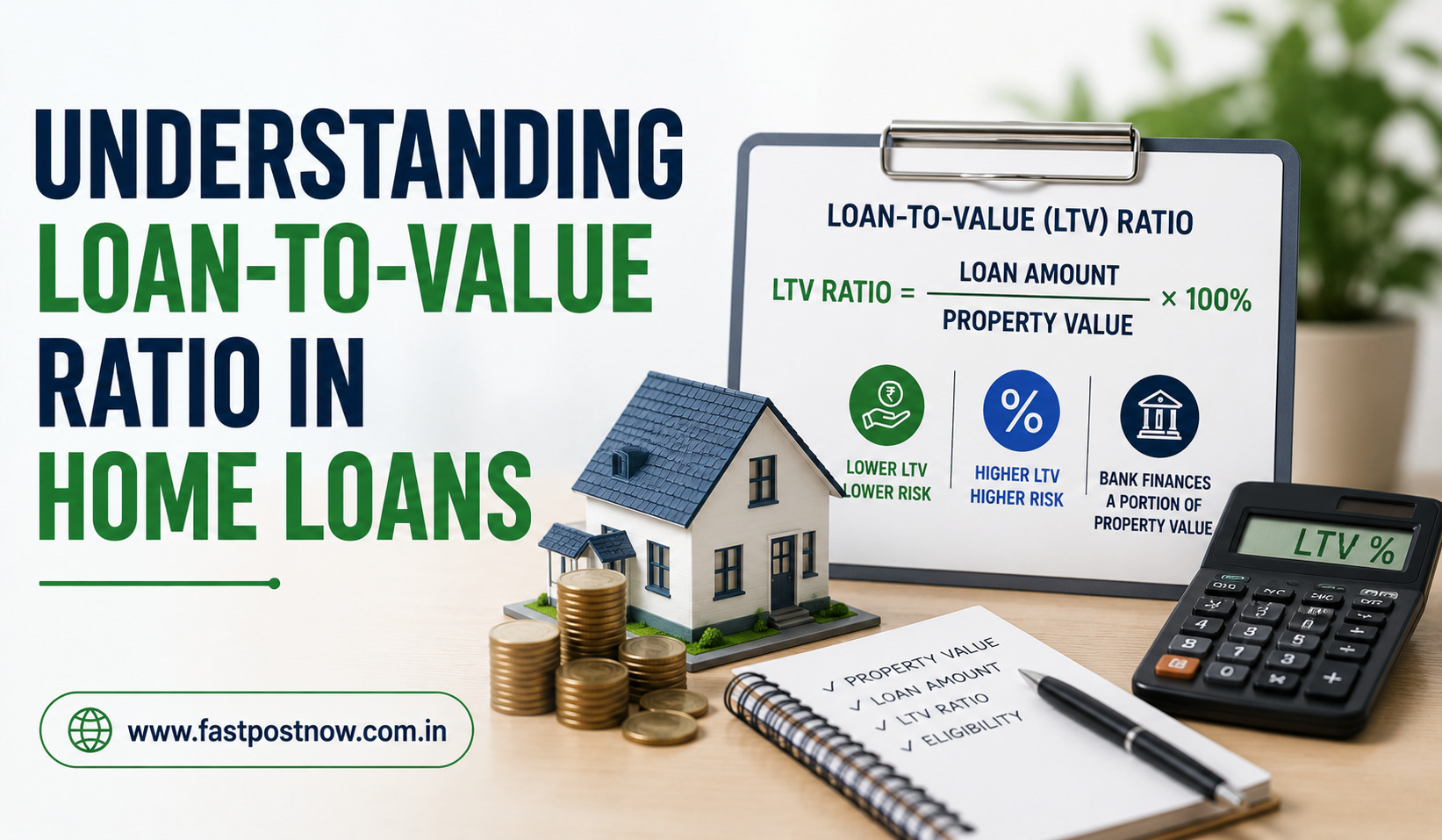
The basic formula is:
LTV = (Loan Amount ÷ Property Value) × 100
For example, suppose a property is valued at ₹60 lakh and you plan to borrow ₹45 lakh.
The calculation would be:
₹45 lakh ÷ ₹60 lakh × 100 = 75%
Your Loan-to-Value Ratio would therefore be 75%.
This means the lender is financing an amount equivalent to 75% of the property’s value, while the remaining 25% represents the portion that must generally come from the buyer’s own funds, subject to the applicable lending terms.
Why Is LTV Important in a Home Loan?
LTV gives lenders an indication of how much of a property’s value is being financed through debt.
A lower LTV generally means the borrower has a larger financial stake in the property. A higher LTV means the lender is financing a greater proportion of the property’s value.
From the borrower’s perspective, LTV helps answer an important question: How much of the property purchase will I need to fund myself?
For example, if a lender is willing to finance 80% of an eligible property value, the borrower may need to provide the remaining 20%, along with other applicable costs.
LTV can therefore affect how much money you need before purchasing a home.
How to Calculate LTV Ratio
Calculating LTV is relatively simple as long as you know the relevant property value and proposed loan amount.
Consider a property valued at ₹80 lakh. If you want a home loan of ₹56 lakh, the calculation is:
₹56 lakh ÷ ₹80 lakh × 100 = 70%
Your LTV is 70%.
If the loan amount increases to ₹64 lakh for the same property, the LTV becomes:
₹64 lakh ÷ ₹80 lakh × 100 = 80%
The higher loan amount results in a higher LTV.
This illustrates why the size of your down payment matters. A larger down payment generally means borrowing a smaller percentage of the property’s value.
LTV Example With a Down Payment
Suppose you want to purchase a home worth ₹75 lakh and have ₹20 lakh available for the purchase.
Ignoring other transaction costs for this simplified example, you would need to finance ₹55 lakh through a home loan.
The LTV would be:
₹55 lakh ÷ ₹75 lakh × 100 = 73.33%
Your contribution would represent approximately 26.67% of the property value.
The relationship can be shown as:
| Property Value | Loan Amount | Approximate LTV | Buyer’s Contribution |
| ₹50 lakh | ₹35 lakh | 70% | ₹15 lakh |
| ₹60 lakh | ₹42 lakh | 70% | ₹18 lakh |
| ₹75 lakh | ₹55 lakh | 73.33% | ₹20 lakh |
| ₹80 lakh | ₹64 lakh | 80% | ₹16 lakh |
The actual amount a lender may approve depends on its policies, applicable regulations, property assessment, borrower eligibility, income, credit history, and other factors.
What Is Considered the Property Value?
One important point is that the value used for LTV may not always be identical to the property’s purchase price.
A lender may conduct or rely on a property valuation to determine the value it is willing to recognize for lending purposes. If the valuation is lower than the agreed purchase price, the borrower may need to provide more of the funding from personal resources.
For example, imagine you agree to purchase a property for ₹70 lakh, but the lender’s accepted valuation is ₹65 lakh. If the lender limits the loan to a particular percentage of the recognized value, the maximum loan may be calculated using ₹65 lakh rather than ₹70 lakh.
This is why borrowers should not assume that a desired loan amount will automatically be approved simply because it falls within a certain percentage of the purchase price.
How LTV Can Affect Your Down Payment
LTV and down payment are closely connected.
If a property is worth ₹1 crore and your loan represents 70% of its value, you would be financing ₹70 lakh and contributing ₹30 lakh from your own funds, before considering other costs.
A lower LTV generally requires a larger upfront contribution.
A larger down payment can also reduce the amount you need to borrow, which may lower your monthly repayment and the total interest paid over the life of the loan.
However, putting every available rupee into a down payment is not always the best approach. Homebuyers should also consider emergency savings, registration-related expenses, furnishing, moving costs, maintenance, and other financial commitments.
LTV and Home Loan Eligibility
LTV is one factor in the home loan approval process, not the only one.
A lender may also consider your income, existing debts, employment or business stability, credit history, repayment capacity, age, and other relevant information.
This means having a low LTV does not automatically guarantee loan approval. Similarly, a borrower with a strong financial profile may still face limits based on the property’s valuation or applicable lending requirements.
It is useful to think of LTV as one part of a larger assessment rather than a standalone measure.
High LTV vs. Low LTV
A high LTV means you are borrowing a larger percentage of the property’s value. This can reduce the amount of money you need to contribute upfront, which may make purchasing a home more accessible.
However, borrowing a larger amount also means taking on greater debt.
A lower LTV generally means a larger down payment and less borrowing. This can reduce the outstanding loan balance and potentially lower interest costs, but it also requires more cash upfront.
The right balance depends on your financial situation.
Potential Advantages of a Lower LTV
A lower LTV can offer several potential benefits:
- Smaller loan principal
- Lower interest costs over time
- Reduced monthly repayment burden
- Greater equity in the property from the beginning
These benefits need to be balanced against the opportunity cost of using more of your savings for the property.
Potential Considerations With a Higher LTV
A higher LTV can make it possible to purchase a property with a smaller upfront contribution. However, the larger loan may increase repayment obligations.
Borrowers should carefully consider whether the resulting monthly payment fits comfortably within their income.
It is particularly important not to stretch your budget simply to reach the maximum loan amount a lender is willing to offer.
Does LTV Affect the Interest Rate?
LTV can influence loan pricing in some lending markets, but the relationship varies between lenders and loan products.
A lender may view a lower LTV as representing lower lending risk because the borrower has more equity in the property. This can potentially influence the terms offered.
However, the interest rate may also depend on factors such as credit history, income profile, loan size, loan tenure, property characteristics, lender policies, and prevailing market conditions.
Therefore, borrowers should compare the actual loan offers available to them rather than assuming that a particular LTV automatically guarantees a specific interest rate.
LTV and Property Prices
Property values can change over time, which means the relationship between your loan balance and property value can also change.
Suppose you initially borrow ₹50 lakh against a property valued at ₹70 lakh. Your initial LTV is approximately 71.43%.
If you repay part of the loan while the property’s value increases, your LTV may decline. For example, if your outstanding loan falls to ₹45 lakh and the property is valued at ₹75 lakh, the ratio becomes 60%.
This can improve your equity position.
However, property values can also fall. A decline in property value can increase the LTV ratio even if you have continued making repayments.
LTV vs. Down Payment: What’s the Difference?
LTV and down payment describe two sides of the same basic financing relationship, but they are not identical concepts.
The down payment is the portion of the purchase price you fund yourself. LTV represents the percentage of the property’s recognized value being financed by the loan.
For a simplified transaction where the property value and purchase price are identical, an LTV of 80% corresponds to a 20% buyer contribution.
However, real transactions can be more complicated because property valuations, fees, taxes, and other purchase costs may not be included in the same calculation.
How to Lower Your LTV
If you want to reduce your LTV, the most direct approach is to reduce the amount you borrow relative to the property’s value.
You can do this by making a larger down payment or choosing a less expensive property.
After taking the loan, regular principal repayment can also reduce your outstanding balance. If the property’s recognized value increases, that may further reduce the ratio.
Before making a large additional payment, however, consider your emergency fund, other debts, investment goals, and any applicable prepayment conditions.
Common Mistakes to Avoid When Considering LTV
One common mistake is assuming that the lender will automatically finance a specific percentage of the purchase price. Lending limits can depend on the lender’s assessment and applicable rules.
Another mistake is ignoring the property valuation. If the lender recognizes a lower value than expected, you may need to provide additional funds.
Some buyers also focus exclusively on getting the highest possible loan. Maximum borrowing capacity should not automatically be treated as an appropriate borrowing amount.
Finally, do not use all your savings for the down payment without considering other homeownership costs. Buying a property can involve expenses beyond the purchase price.
Frequently Asked Questions About Loan-to-Value Ratio
What is a good Loan-to-Value Ratio for a home loan?
There is no single LTV that is ideal for every borrower. A lower ratio generally means more equity and less borrowing, while a higher ratio can reduce the upfront cash requirement. The appropriate level depends on your finances and the lender’s terms.
Is a higher LTV better?
A higher LTV can make it possible to borrow more with a smaller down payment, but it also means taking on more debt relative to the property’s value. Whether that trade-off is appropriate depends on your repayment capacity.
Does LTV affect home loan approval?
It can. LTV is one factor lenders may consider when assessing a home loan. However, approval can also depend on income, existing obligations, credit history, property valuation, and other eligibility criteria.
How does a down payment affect LTV?
A larger down payment generally reduces the loan amount and therefore lowers the LTV. A smaller down payment generally results in a higher LTV.
Can LTV change after taking a home loan?
Yes. LTV can change as you repay the principal, as the property’s recognized value changes, or as both occur. A lower outstanding loan balance generally reduces the ratio if the property value remains unchanged.
Is LTV calculated using the purchase price?
Not necessarily. Depending on the lender and applicable rules, the LTV calculation may use a property value determined or accepted by the lender rather than simply the agreed purchase price.
Should I borrow the maximum amount allowed by my LTV limit?
Not necessarily. A lender’s maximum is not the same as your ideal borrowing amount. Consider your monthly budget, emergency savings, other debts, long-term goals, and ability to handle unexpected expenses.
Final Thoughts
Loan-to-Value Ratio is an important concept for anyone considering a home loan. At its simplest, it tells you how much of a property’s value is being financed through borrowing.
A higher LTV can reduce the amount you need to provide upfront, but it generally means taking on more debt. A lower LTV requires a larger contribution but can result in a smaller loan and greater initial equity.
Before applying for a home loan, calculate your expected LTV and consider how the resulting loan would fit into your overall finances. Do not focus only on the maximum amount you can borrow. Think about the monthly repayment, total borrowing cost, emergency savings, and other expenses associated with owning a home.
Understanding LTV gives you a clearer picture of the relationship between your property, down payment, and loan. With that knowledge, you can approach the home-buying process with more realistic expectations and make borrowing decisions that better suit your long-term financial plans.

